

Why Are There So Many Kinds of Korean Fried Chicken?
Maya, who appears in this article, is a fictional character inspired by an American traveling in Korea.
Rather than presenting Korean food as an exaggerated tourist experience, this article follows Maya as she sees how people in Korea actually order and enjoy it in everyday life.
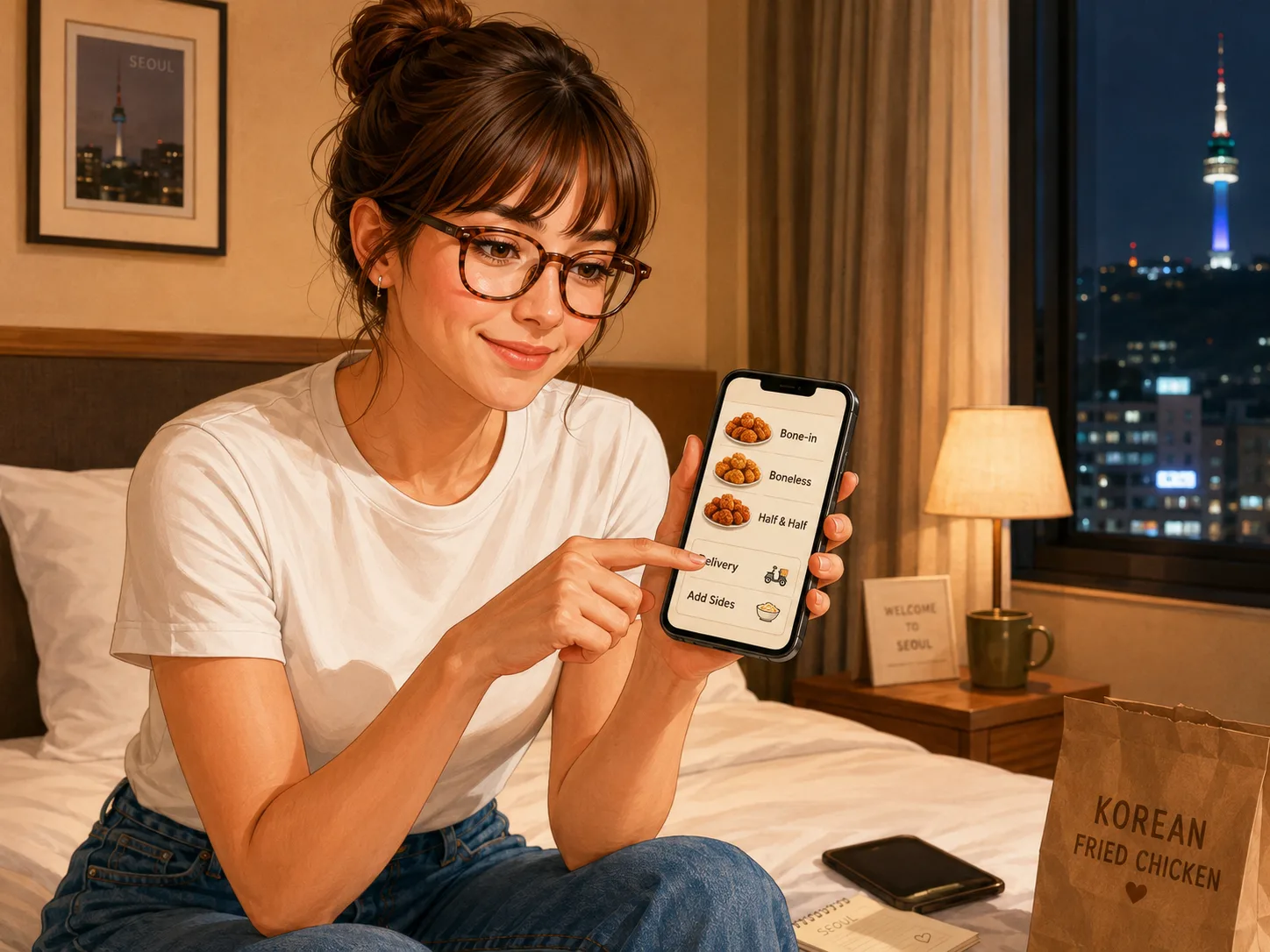
After spending all day walking around Seoul, Maya sat on the bed in her accommodation that evening and opened a food-delivery app on her phone.
Tonight’s plan was simple: chicken and beer.
But as Maya scrolled through the menu, her hand would not stop.
Fried, Sweet & Spicy, Soy Garlic, Green Onion, Cheese Powder, Oven-Baked…
Chicken was familiar to her from the United States, but the Korean chicken menu seemed to have an unusually large number of choices.
Almost forgetting how hungry she was, Maya stared at the menu for a long time. Even a familiar food like chicken came in so many styles and combinations in Korea that deciding what to choose felt like part of the fun.
“Can choosing one chicken order really be this exciting?”
That evening, Maya felt a little closer not only to the food itself, but also to the way people in Korea choose delivery food and enjoy it together.

Start with the basics
The natural starting point for Korean chicken is classic fried chicken.
Its crisp coating and clean, savory chicken flavor are easy to appreciate, so it is a comfortable choice for a first order. Another advantage is that you can dip it into different sauces.
Next comes yangnyeom chicken (Sweet & Spicy Chicken). The fried chicken is coated in a red sauce that combines gochujang, garlic, and sweetness, creating one of the signature flavors of Korean chicken. Half-and-half chicken, with one half fried and the other half seasoned, has also been a longtime favorite.
For her first order, Maya finally added half fried and half yangnyeom chicken to her cart.
“If choosing one is difficult, I can just choose two.”
Once she had selected the menu and completed the order, Maya felt relieved, as though a small decision had finally been settled. Only then did the excitement of having Korean fried chicken delivered for the first time begin to feel real.
To Maya, having food arrive after just a few taps on a screen felt remarkable. She also realized that in Korea, ordering exactly what you want and having it delivered wherever you are is already a natural part of everyday life.

How are soy garlic chicken and yangnyeom chicken different?
Scrolling farther down, Maya also found soy garlic chicken.
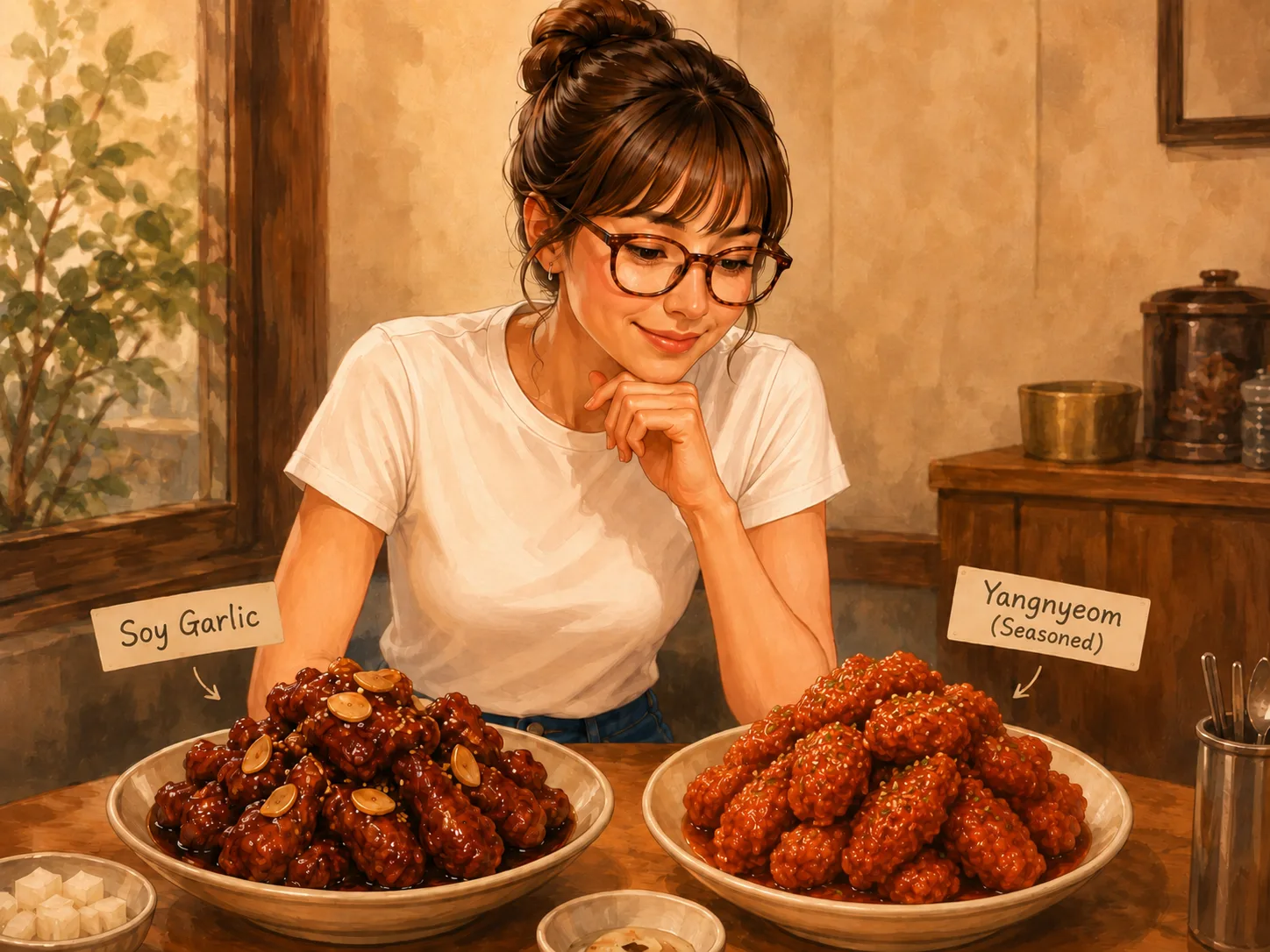
Yangnyeom chicken has a sweet yet spicy flavor from its red sauce, which is usually made with gochujang or red pepper flakes.
Soy garlic chicken, by contrast, has a darker glaze made with soy sauce, garlic, and sweetness, giving it a mainly savory-sweet flavor.
If you do not handle spicy food well, soy garlic chicken may feel like the easier choice, although some brands add pepper or chili for a mild kick.
Maya went back and forth between photos of the two dishes. She wanted to try the sweet heat of Korean yangnyeom chicken, but the glossy soy glaze made the savory-sweet option hard to give up.
“They both look delicious, but tonight I’ll start with yangnyeom chicken. It feels a little more like I’m really in Korea.”
She saved the soy garlic chicken for her next order. Before she had even finished choosing dinner, Maya’s chicken list already had another item waiting.
Why does every brand have its own signature flavor?
When Korean chicken brands are compared side by side, you can see how they compete to turn the same basic ingredient into completely different foods.
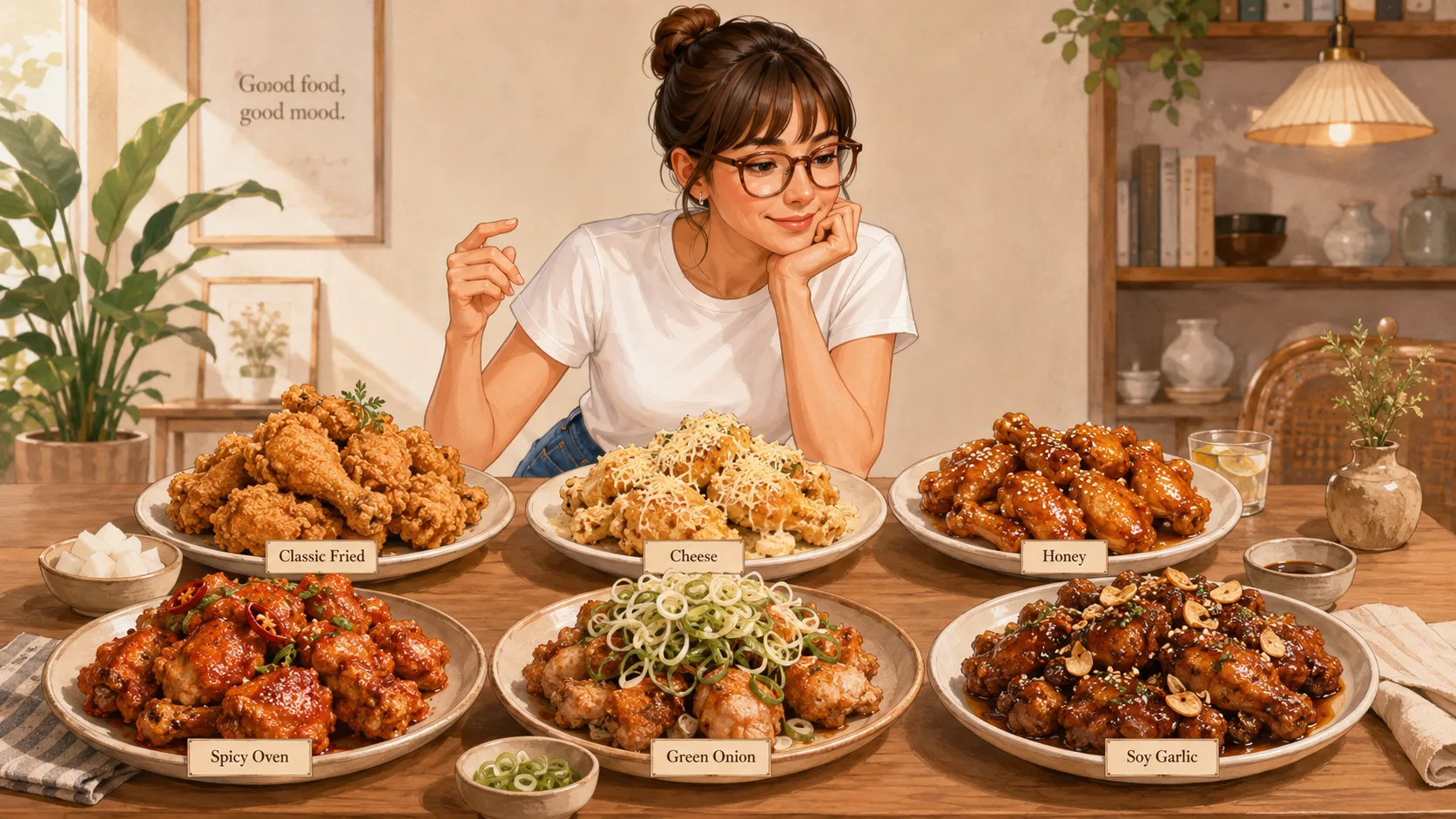
Some brands emphasize the crispness of plain fried chicken, while others lead with a distinctive flavor such as cheese seasoning, soy glaze, green-chili mayonnaise, or oven-baked chicken.
Each brand has steadily developed “the one flavor that makes people think of our chicken,” helping create the wide range of choices available today. This can also be seen in the brands’ current official menus.
These were some of the brands and signature menu items Maya repeatedly saw on the ordering screen.
• BBQ — Golden Olive Chicken
A signature item that highlights the crispness of classic fried chicken without a sauce coating.
• bhc — Bburinkle, Macho King
Bburinkle is coated in a cheese-based seasoning, while Macho King is known for its sweet-and-savory soy-based flavor.
• Kyochon Chicken — Honey Combo, Soy Sauce Series
Its best-known choices include Honey Combo, made mainly with wings and drumettes coated in a sweet honey sauce, and its soy-based chicken series.
• Goobne Chicken — Gochoo Basasak
Goobne focuses on oven cooking rather than deep-frying, with Gochoo Basasak and Volcano among its main menu items.
• Nene Chicken — Cheese Snowing, Oriental Padak
Cheese Snowing, coated in cheese powder, and Oriental Padak, topped generously with green onions, show the brand’s distinctive style.
• Puradak — Black Aglio, Gochu Mayo
Black Aglio combines a rich soy glaze with garlic chips, while Gochu Mayo pairs mayonnaise with green chili.
Maya studied the menu for quite a while. With so many choices, picking just one was not easy, but even the decision-making process felt enjoyable.
She was fascinated that such a familiar food could be enjoyed in so many different ways in Korea, and she began looking forward to what she might try next.
Signature items and availability can vary by season and location, so it is best to check the menu of the nearest store when you are ready to order.

Choices to make when ordering chicken in Korea
Even after Maya chose the menu, the decisions were not over.
First, she had to choose between bone-in chicken and boneless chicken. In this context, “one whole chicken” usually does not mean that an intact chicken arrives at the table. It generally means one chicken’s worth, cut into pieces and cooked.
Next, she checked the cut and flavor she wanted.
Whole Chicken / Wings / Drumsticks / Boneless
Fried / Seasoned / Soy Garlic / Spicy
One Flavor / Half & Half
When yet another selection screen appeared, Maya laughed. She had thought she was simply ordering chicken, but it felt as though she were filling out a short questionnaire.
Common sides include fries, cheese balls, tteokbokki, and sotteok-sotteok.
Whether pickled radish, drinks, and sauces are included or sold as add-ons—and the delivery charge—can vary by store. Delivery orders may also come with a separate delivery fee.
Maya entered the exact building name of her accommodation and instructions for delivering the order to her room. A moment later, the estimated arrival time appeared on the screen, and all she had to do was wait.
When she saw the order-confirmation message, Maya felt proud, as though she had completed a small challenge.
There was no longer any need to compare menus or check the options again.
When the chicken arrives, it is time for chimaek
The doorbell rang, and a warm box of chicken arrived.
Maya took a cold can of beer from the refrigerator. The moment she bit into a crisp piece of chicken and followed it with a sip of cold beer, she naturally understood why the two were so often enjoyed together.
After her first sip, Maya let out a long breath without realizing it. Only then did her body, tense after walking around Seoul all day, seem to arrive back at the accommodation with her.
The refreshing beer cut cleanly through the savory richness of the chicken, creating a strangely satisfying balance that made her reach for another piece. Maya began to think of it not simply as a meal to fill her stomach, but as food well suited to unwinding after a long day and sharing with other people.
“Now I understand why people in Korea remember eating chicken as a happy moment in itself.”
To Maya, her first chimaek felt less like simply eating food and more like getting a small taste of Korean evening culture.
Chimaek combines the Korean words for chicken and beer. Rather than a formal ritual, it is an easygoing pairing that naturally appears when people watch sports or dramas at home or spend a relaxed evening with friends. It has become such a familiar part of popular culture that large chimaek festivals are held around it.
Chicken and beer can sometimes be delivered together from a restaurant, but alcohol orders require age verification, and you may be asked to show identification when the order is handed over.
Maya turned on a Korean drama and alternated between fried and yangnyeom chicken.
The yangnyeom chicken was sweet and rich, while the fried chicken stayed crisp to the last piece. A bite of pickled radish refreshed her mouth and somehow made her reach for the chicken all over again.
It was not a special sightseeing itinerary.
She had simply ordered chicken to her accommodation, opened a can of beer, and eaten an ordinary dinner.
But Maya felt that this was exactly why the evening might stay with her for a long time.
It did not feel like a scene staged for travelers. It felt as though she were sharing and enjoying the kind of evening people in Seoul might actually spend.
That ordinary sense of comfort was what showed Korean chicken culture most realistically.

What Maya learned
Korean chicken comes in so many varieties for more reasons than simply having many sauces.
Starting with familiar fried chicken, each brand has added its own direction through flavors and styles such as yangnyeom, soy garlic, green onion, cheese seasoning, spicy sauces, and oven baking.
That is why ordering chicken in Korea is not about choosing one correct answer.
Today, half fried and half yangnyeom; next time, soy garlic; after that, perhaps padak or Gochoo Basasak.
As Maya cleared away the empty chicken box, she thought:
“Maybe Korean chicken is not something you try once and move on from. Maybe it is something you order again and again until you find your favorite combination.”
Next time, she thought, choosing from the menu might take a little less time than it had today. Then again, perhaps it would not.
After all, the list of chicken she wanted to try had only grown longer.
Comments 0
Please log in to comment.
No comments yet. Start the conversation.