

Moments of Jeong Experienced by a Foreign Traveler in Korea
Maya, who appears in this article, is a fictional character based on an American traveling in Korea.
This does not mean that every Korean shows kindness in the same way. Through the small acts of help a traveler might encounter, we explore the meaning of what Koreans call jeong.
Maya first heard the word jeong at a small restaurant in Seoul.
As she was about to get up after finishing her meal, the owner poured her another cup of warm barley tea and said,
“Take your time and finish your tea.”
She had not asked for anything extra, nor had they shared any special conversation. Yet that brief moment stayed with Maya for a surprisingly long time.
The Korean word jeong is difficult to translate precisely with a single English word such as kindness or love. It is closer to a feeling that blends affection, connection, and care built between people, and it is generally said to develop through shared time and experiences.
Could Maya, who was only visiting Korea for a short time, feel jeong too?

Someone Who Walks With You, Not Just Points the Way
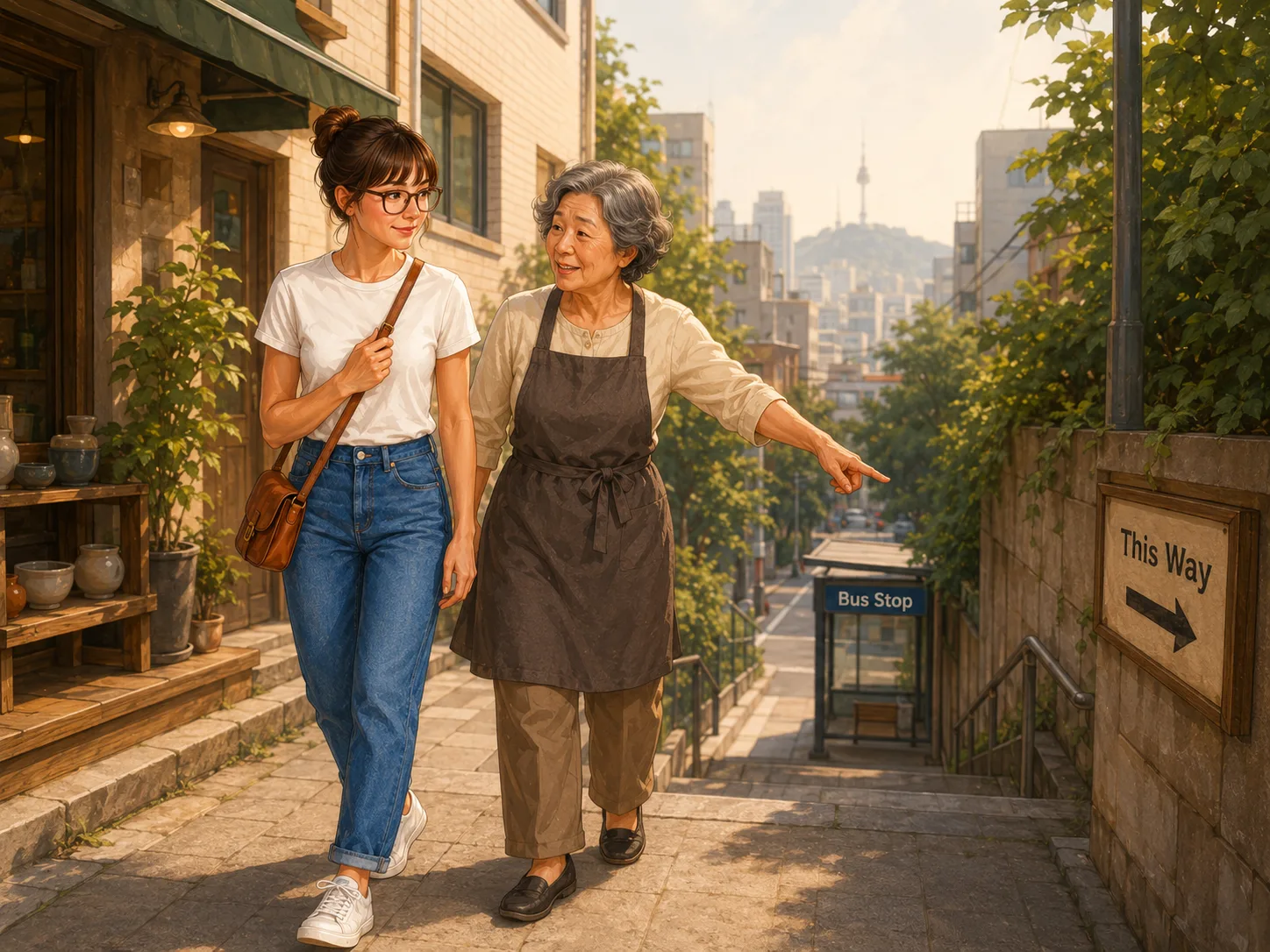
Not long after arriving in Seoul, Maya got lost in an alley while looking for a bus stop.
The map showed that her destination was right in front of her, but she could not find the entrance. When Maya showed her phone screen to a nearby shop owner, he tried explaining the directions with his hands, then eventually began walking ahead of her.
Only after they had passed one block and gone down a small set of stairs did the bus stop come into view.
“Here. Bus.”
He did not know much English, but he personally made sure Maya reached the place where she could catch her bus.
To Maya, it felt a little different from simply giving directions. Instead of pointing the way and continuing on with his day, he took the extra step of making sure she found the right place.
The Language of Food That Says, “Have a Little More”
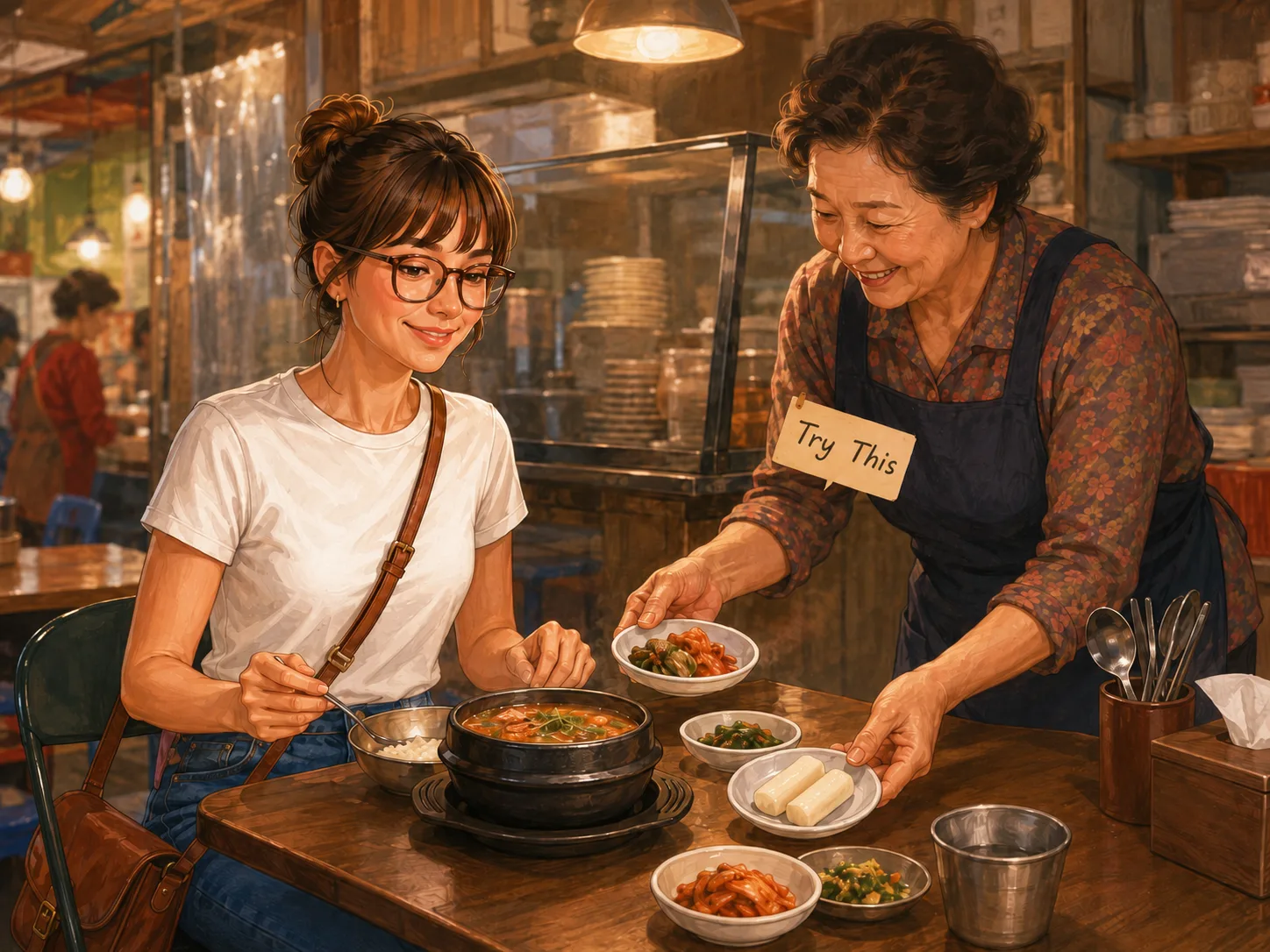
A few days later, Maya ate lunch alone at a small restaurant inside a market.
After she ordered a bowl of noodles by pointing to a photo on the menu, the owner set down the side dishes and asked whether she could handle spicy food.
“A little spicy is okay.”
When Maya answered carefully, the owner smiled and brought her another, milder side dish.
As she was nearly finished eating, the owner also placed two small pieces of tteok, or rice cake, on her plate.
“Service.”
At first, Maya thought it was something she had ordered in addition and reached for her wallet.
Only when the owner waved her hand and smiled did Maya realize that the food was complimentary.
“I’m just eating alone in a small restaurant, and she’s taking such good care of me.”
What felt warmer than the piece of rice cake itself was the natural concern shown to a stranger.
Maya began to think that what Koreans call “service” might mean more than simply giving away free food. It could also reflect a desire to take a little extra care of a guest.
Receiving an extra side dish or a small serving of food at a Korean restaurant does not always indicate a deep personal connection.
Sometimes it may be part of the restaurant’s service culture, and other times it may simply be a personal act of kindness from someone you happened to meet that day.
In Korean culture, however, sharing food has long been regarded as a way of expressing care and a sense of communal connection.
Making and sharing tteok is also described as a tradition that symbolizes harmony and jeong within a community.
What mattered to Maya was not that she had received free food.
It was that someone had first considered what she could eat comfortably.
Small Acts of Help Offered Without a Word
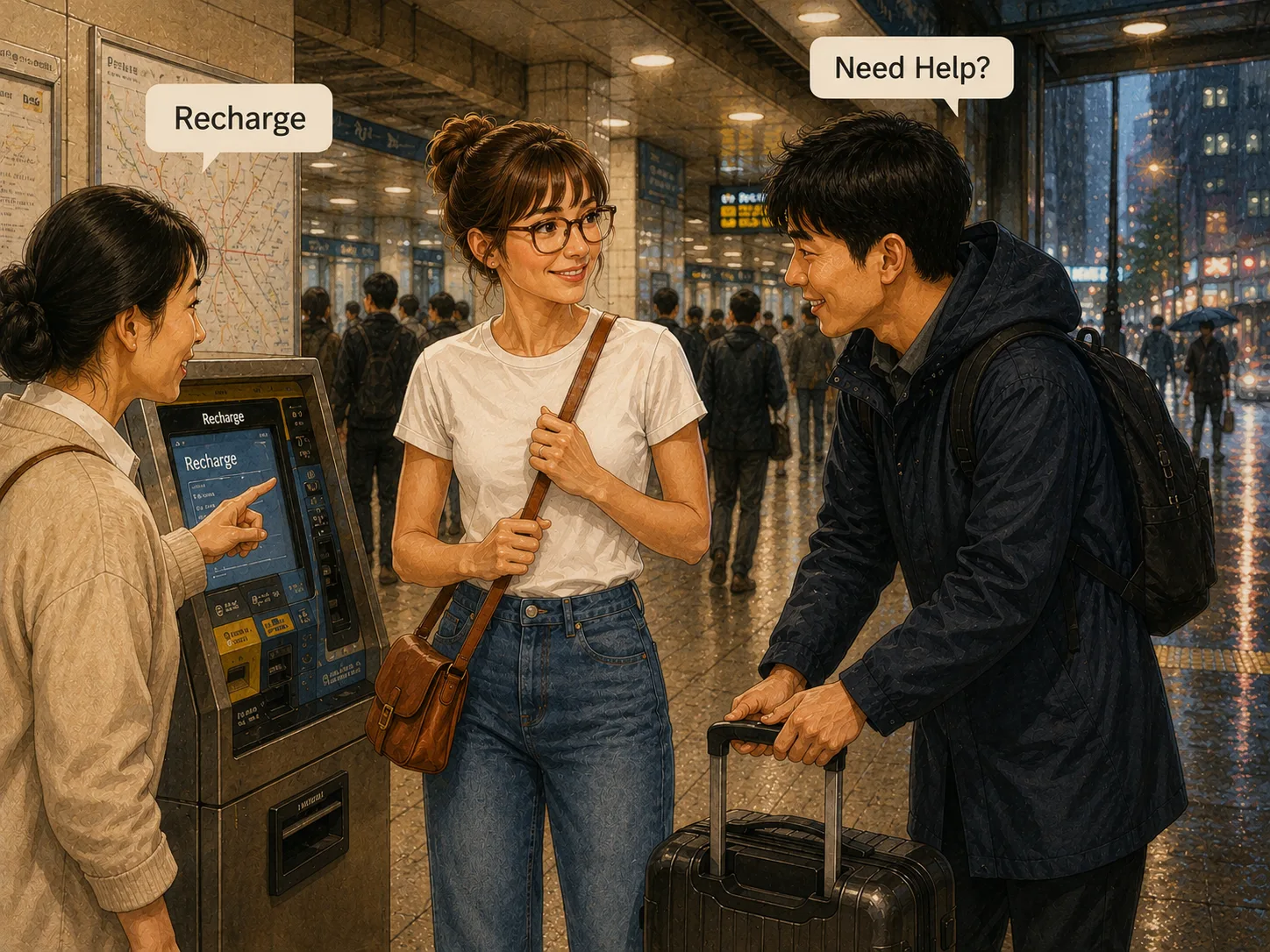
One evening, as rain poured down, Maya became flustered when her transit card would not work at the subway gate.
The person standing behind her did not rush her and simply pointed to the card-reloading machine nearby.
Another passenger saw Maya trying to carry her wet suitcase down the stairs and briefly lifted it by the lower handle to help.
The people who helped her did not stop for a long conversation. One gave a slight bow and disappeared, while the other put their earphones back in and continued on their way.
“They noticed I was struggling and helped me without saying a word. That feels so warm.”
Maya learned that kindness in Korea is not always expressed through a bright smile or a long conversation.
Quietly lending a hand when it is needed, without making the other person feel uncomfortable, was also a profound form of consideration.
Is Jeong the Same as a Single Act of Kindness?
Maya wanted to call every bit of help she received during her trip jeong.
Her Korean friend explained it a little differently.
“You can show kindness to someone the first time you meet them, but jeong usually builds as you spend time together.”
Jeong is closer to the accumulation of a relationship than to a simple favor. Koreans may say they have developed jeong not only for people close to them, but also for a shop they have visited for years, an object they have used for a long time, or a familiar place.
It would therefore be difficult to say that deep jeong had already formed between Maya and the person who showed her the way or the restaurant owner who shared food with her.
Still, those small gestures held a warmth similar to the way jeong begins to grow.
They reflected an attitude of paying a little more attention to someone, taking care of what they need before they ask, and not calculating what the relationship might offer in return.

Not Generalizing Kindness to an Entire Culture
Maya did not receive help at every moment during her time in Korea.
Some people answered her questions briefly when they were busy, and there were moments when both sides felt flustered because they did not share a language.
Sometimes a blank expression initially seemed unfriendly, only for Maya to realize later that the person had simply been in a hurry or expressed themselves differently.
Jeong is not a word meant to support the claim that “all Koreans are kind.”
Nor is there any need to exaggerate every extra serving of food or act of help a traveler receives as a special symbol of Korean culture.
Everyone has a different personality, and experiences also vary depending on the region and circumstances.
Understanding jeong in its cultural context does not mean reducing Koreans to a single image. It means recognizing that ways of expressing connection and care may differ from those you are used to.
The Moment of Jeong That Stayed With Maya
The day before leaving Korea, Maya happened to pass the shop where she had asked for directions near the beginning of her trip.
The owner did not recognize Maya right away. Maya did not go inside for a long farewell either.
She simply gave a slight bow through the window. After looking at her for a moment, the owner smiled and waved.
They had not become especially close.
Yet to Maya, that alley was no longer a street without meaning.
It was where she had first become lost, where someone had walked with her, and where that memory made her want to return.
Only then did Maya feel that she was beginning to understand the Korean expression jeong-i deulda—to grow attached.
Perhaps jeong is not the name of some grand act of kindness, but a small trace left in the heart that makes us think once more of a person or place.

Comments 0
Please log in to comment.
No comments yet. Start the conversation.