

How a One-Day Health Checkup Works in Korea
Maya, who appears in this article, is a fictional character inspired by an American woman in her late twenties visiting Korea.
Health-screening preparation and test items vary depending on a person’s age, health, and medical provider, so once you make an appointment, follow the screening center’s instructions first.
While planning her trip to Seoul, Maya wrote “Health Checkup” on one side of her itinerary.
As she organized her medical records from the United States, she realized it had been a long time since her last blood test. She had also heard that Korea had a well-developed health-screening system, so she wanted to use one day of her trip to check her current health.
Her first question was simple.
“Can I really complete all the tests in one day?”
In Korea, comprehensive health checkups often take place at a single screening center, where measurements, blood tests, imaging, and other exams are completed in sequence instead of requiring separate visits to several departments.
A basic screening may finish sooner, while a comprehensive checkup generally takes about three to four hours. More extensive programs with additional tests may continue for another one to two hours.
Here, however, a one-day checkup mainly means that the testing process itself is completed in one day.
It does not necessarily mean that every result and the final consultation with a doctor will also be completed that same day.


When booking, choose the tests you need—not simply the most expensive package
After requesting an appointment through the hospital website, Maya adjusted the test list by email with an international patient coordinator.
Comprehensive screening centers in Korea often offer several packages, such as basic, cancer-focused, and cardiovascular screenings, with optional tests available as add-ons.
When booking, it helps to provide your English name exactly as it appears on your passport, date of birth, preferred date, current medications, medical history, and family history accurately.
At some centers, a nurse reviews the online request before the final schedule is confirmed.
Maya initially assumed that more tests would always be better, but she was told that repeated, unnecessary CT scans can increase exposure to medical radiation, so it is important to choose appropriate tests in consultation with a professional.
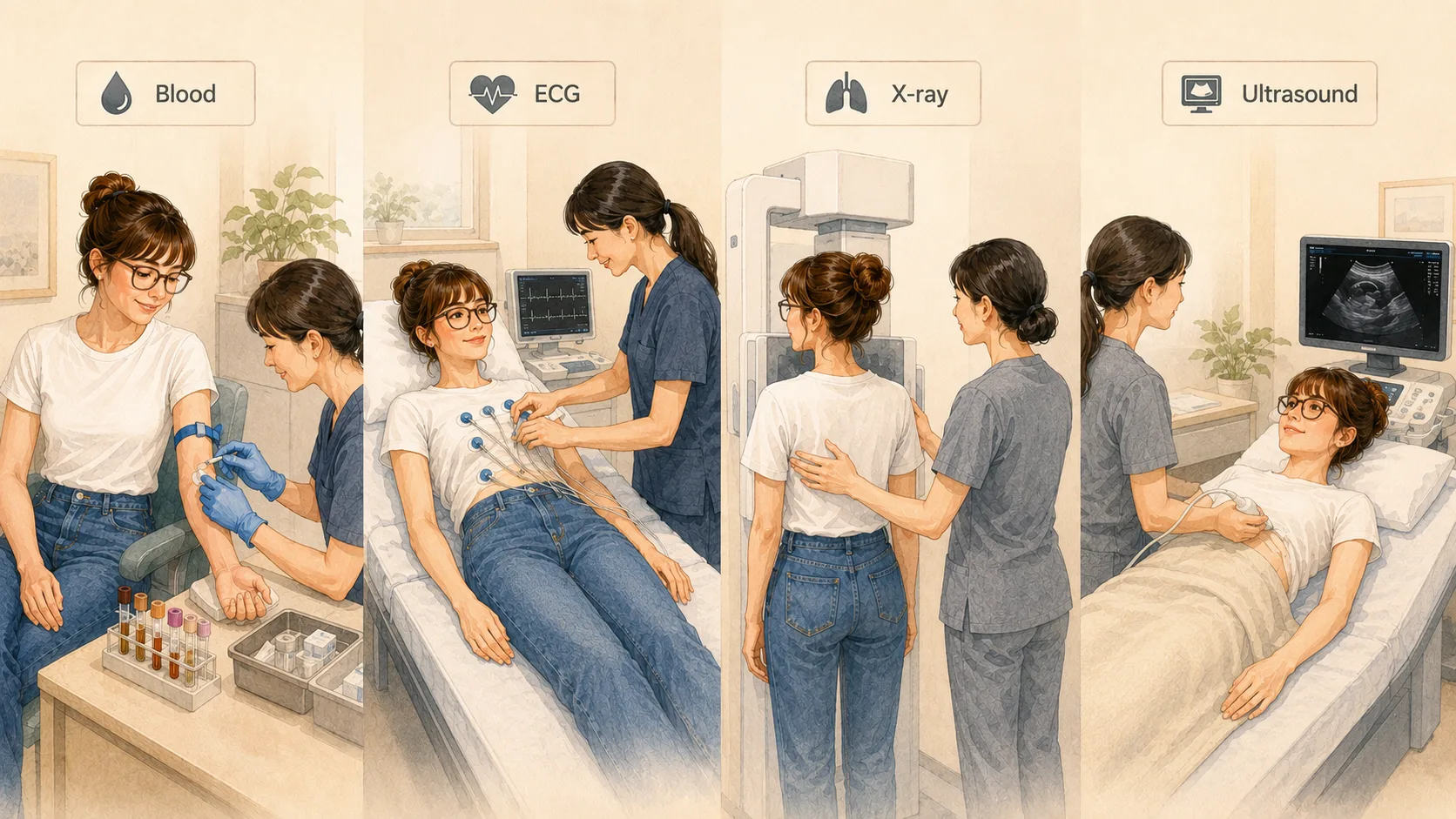
She chose a program that included basic blood and urine tests, a chest X-ray, an ECG, and an abdominal ultrasound.

The day before, confirm dinner and fasting instructions
On the evening before the screening, Maya read the instructions again at her accommodation.
Samsung Medical Center’s Health Promotion Center, for example, instructs visitors to avoid food, water, gum, and smoking for at least ten hours before the appointment.
Fasting may be required not only for blood tests but also for exams such as an abdominal ultrasound.
However, rules for drinking water and taking medication can vary by institution and test, so follow the instructions from the center you booked rather than general information found online.
Maya ate a light dinner and stopped eating before midnight.
She did not stop her regular medication on her own, but prepared according to the instructions she had confirmed when booking.
If a colonoscopy is included, preparation begins earlier.
Some centers require dietary changes starting three days before the exam and bowel-preparation medication at the specified time the day before.

After check-in, the tests continue within one center
At 8:00 a.m. on the day of her checkup, Maya arrived with her passport and appointment confirmation.
After checking in and paying, she changed into screening clothes and moved between exam rooms using the information on a wristband or routing sheet.
Some centers use computerized scheduling to adjust the order of tests and reduce waiting time.
First, her height, weight, and blood pressure were measured. Next came blood and urine tests, followed by an ECG and chest X-ray before she moved to the abdominal ultrasound room.
The exact items in a comprehensive screening depend on the package, but the following tests are commonly combined.
Body Measurements · Blood & Urine · ECG · Chest X-ray · Ultrasound · Endoscopy
Blood tests may assess anemia, liver and kidney function, blood sugar, cholesterol, and thyroid function.
Imaging exams look for structural abnormalities in organs of the chest or abdomen.

If you choose endoscopy, keep the afternoon free
Maya also booked an upper endoscopy, but she did not choose sedation.
After a sedated endoscopy, it may take time for judgment and balance to return fully.
Some screening centers require a companion to take the patient home and prohibit driving on the day of the procedure; they may cancel sedation if the patient arrives without a companion.
For that reason, on a day that includes sedated endoscopy, it is more realistic to rest at her accommodation than to head straight to a tourist site or schedule an important appointment.
Maya also decided not to plan spicy food or alcohol after the screening, and instead to have a light meal nearby before returning to her accommodation.

The tests take one day, but final results may come several days later
A little after noon, Maya had completed all of her tests.
She could receive a brief explanation of the basic measurements and information available that day, but
the final report, including blood analysis and imaging interpretation, would be provided later.
The Korea Tourism Organization describes comprehensive screenings that take about four hours, with results generally available within a week.
Samsung Medical Center, on the other hand, notes that the final consultation may take place seven to fourteen days after testing, depending on the types of exams and the medical team’s schedule.
Some international patient programs explain whatever results are available on the same day, so the most reliable approach is to ask when both the same-day explanation and the final results consultation will be available.
Maya also asked in advance whether she could receive the results by video consultation or email after returning home.
Some centers offer reports by email or mail in addition to in-person consultations.

A health checkup is a starting point for understanding your current condition, not treatment
Maya’s results did not show any problem requiring immediate treatment, but the report advised her to monitor her cholesterol and pay attention to her lifestyle habits.
A health checkup is a preventive screening intended to identify risk factors in people without symptoms.
A normal screening result cannot rule out every disease, and if you already have symptoms such as weight loss or pain, you should seek a separate medical evaluation for those symptoms rather than relying only on a general screening.
If an abnormal finding is detected, additional testing and specialist care may be needed.
Maya summarized the process this way.
Book the appointment and adjust the test list.
Fast according to the center’s instructions.
Complete blood tests and imaging exams in sequence.
Distinguish between information available that day and the timing of the final results.
Follow up abnormal findings with specialist care.
A one-day health checkup in Korea was not an experience of simply taking as many tests as possible.
For Maya, it was a chance to use one day of her trip to understand her current condition and
identify what she should pay attention to going forward.
The testing ended in one day, but the process of reviewing the results carefully and understanding her health needed to continue afterward.
Comments 0
Please log in to comment.
No comments yet. Start the conversation.