

Finding Seoul in K-Dramas and Animation
Maya, who appears in this article, is a fictional character inspired by an American traveler visiting Korea.
This story follows her through a leisurely day of comparing places from the screen with the everyday spaces of Seoul.
After arriving in Seoul, Maya kept coming across scenes that felt familiar.
High-rises beyond tiled roofs, people walking beside old stone walls, and a tower glowing above Namsan after dark.
On screen, each one had looked like a perfectly composed backdrop. In real life, those places were also filled with commuters and residents, the sound of traffic, and small neighborhood shops.
Maya opened the scenes she had saved on her phone one by one and wondered:
“How much does the Seoul on screen resemble the real city?”

10:30 a.m. — Bukchon, in Search of the Tiled Roofs from Animation
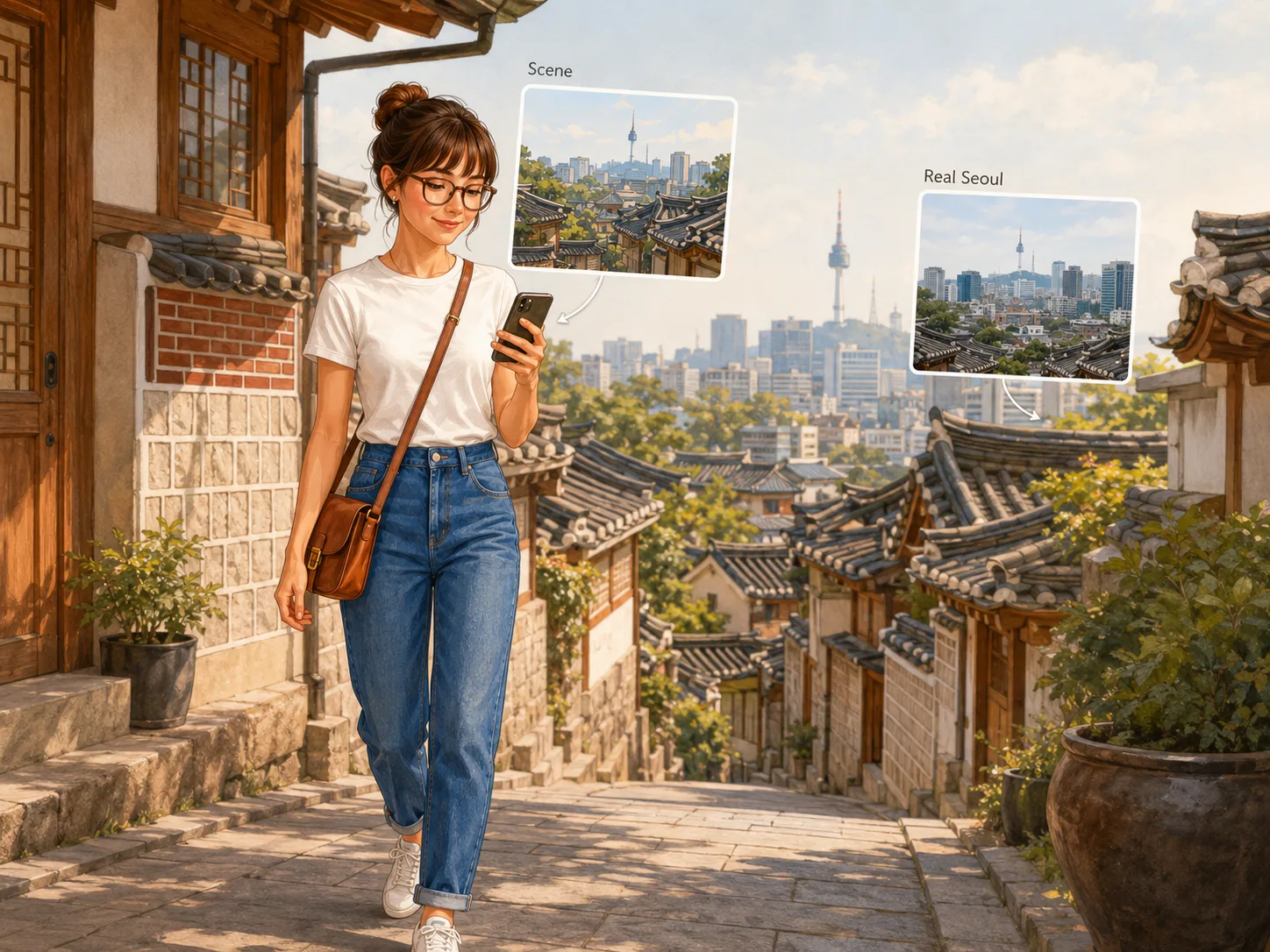
Maya’s first stop was Bukchon Hanok Village.
It was reimagined as the setting where Rumi and Jinu first meet in the animated film KPop Demon Hunters and later walk among tiled rooftops. The production team reportedly drew on Seoul’s actual terrain and location photos, then heightened the buildings and colors with the distinctive exaggeration of animation.
The scene on Maya’s phone framed hanok rooftops and Namsan together. The real Bukchon, however, was a lived-in neighborhood of narrow alleys, steep slopes, and residents’ homes.
Instead of searching for the exact spot in the image, Maya wandered slowly through the alleys. When a modern building appeared behind a hanok roof, old Seoul and present-day Seoul seemed to overlap naturally.
“It didn’t look exactly like the picture, but walking through it helped me feel the real atmosphere of Bukchon.”
For photos, use a wide frame that captures the alley without blocking the entrance to anyone’s home. In particular, visitors are permitted in parts of Bukchon-ro 11-gil only from 10 a.m. to 5 p.m., and entering during restricted hours may result in a fine.

Nearby Stops
After exploring Bukchon, add one nearby place to your route.
• Gyeongbokgung Palace — Traditional Korean palace scenery
• MMCA Seoul — Contemporary art and a relaxed museum visit
• Insadong — Traditional crafts, tea, and souvenirs
It can also be fun to recall how Gyeongbokgung appears in KPop Demon Hunters and compare it with the view in front of you.
2:00 p.m. — Following a Quiet K-Drama Conversation to the Deoksugung Stone Wall Road
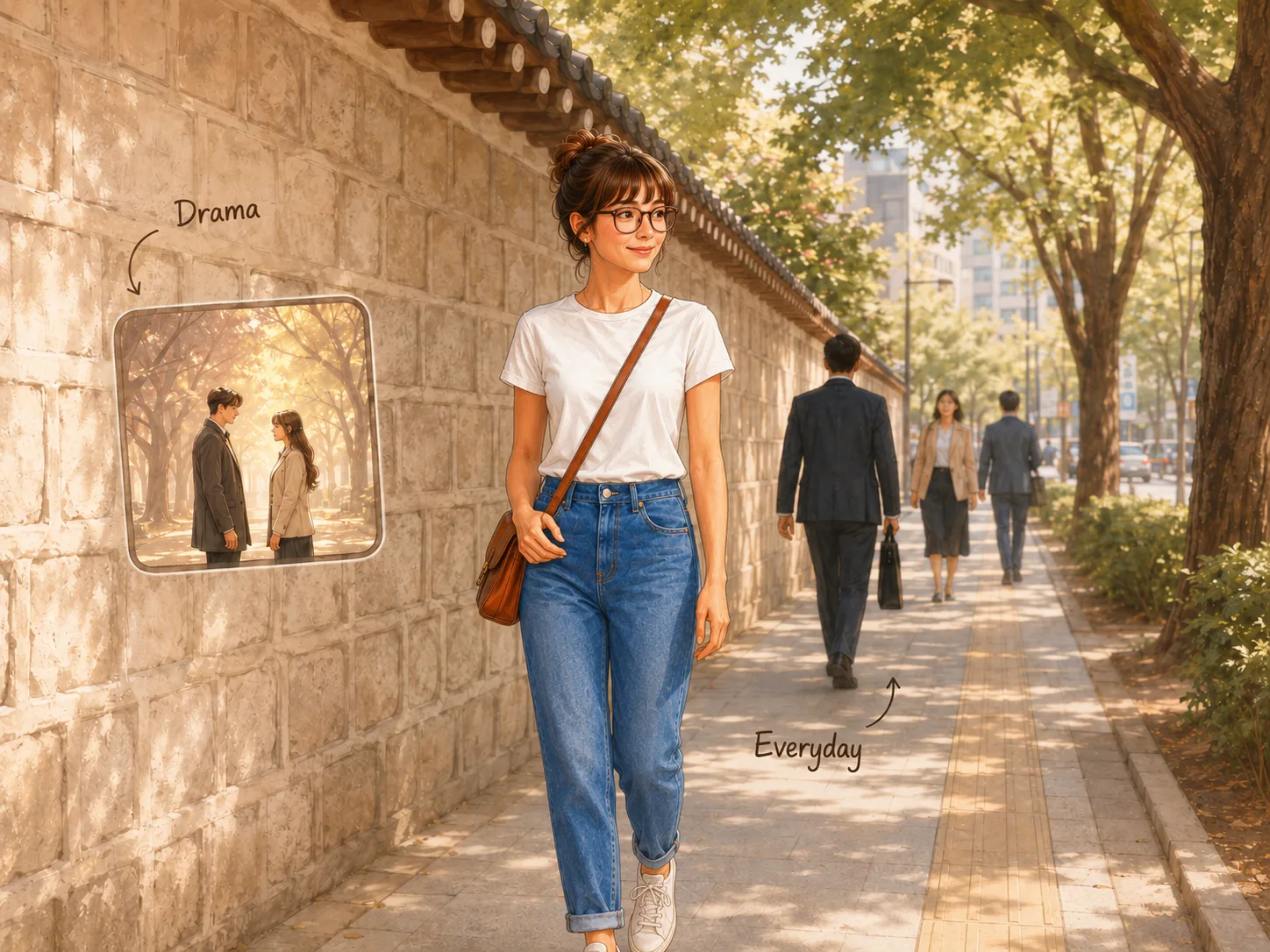
After lunch, Maya headed to the Deoksugung Stone Wall Road near City Hall Station.
This street has appeared in many Korean dramas, including Goblin. On screen, it is portrayed as a quiet, romantic setting that reflects the characters’ emotions. In reality, it feels more like an urban walking path beside the palace wall, shared by office workers and visitors.
Rather than trying to recreate a drama scene exactly, she took photos where the stone wall and roadside trees came together naturally.
Maya took her time photographing a spot where the stone wall and trees filled the view. As she watched warm sunlight and leafy shadows fall across the wall, it felt as though time had briefly slowed in the middle of busy Seoul.

Nearby Stops
After walking along the wall, visit another nearby place.
• Seoul Museum of Art — Exhibitions and a quiet break
• Jeongdong-gil — A walking street lined with stone walls and trees
• Seoul Plaza — City views and a broad place to rest
Stopping at a café along the way is another pleasant way to enjoy an ordinary Seoul afternoon at an unhurried pace.
6:30 p.m. — In Search of the Seoul Nightscape from Itaewon Class
As the sun began to set, Maya took the subway to Noksapyeong Station.
The Noksapyeong pedestrian overpass near the station is a filming location from Itaewon Class. From the bridge, you can frame the road, the Itaewon area, and N Seoul Tower on distant Namsan in a single view. The Seoul Metropolitan Government also highlights the overpass, Gyeongnidan-gil, and World Food Street as key locations featured in the series.
Maya looked for an angle close to where the character had stood in the drama.
Once she stepped onto the bridge, headlights streamed endlessly below and commuters continued past her. The city felt more vivid and beautiful than she had expected, and Maya stopped for a moment to take it in.
She composed the photo so that the railing led toward N Seoul Tower, bringing the moving city and the distant glowing tower naturally into the same frame.
Looking at the finished photo, Maya liked it even more than a faithful recreation of the drama scene. It seemed to hold the atmosphere of Seoul on that particular evening.
This is both an Itaewon Class filming location and a place where you can see N Seoul Tower, a symbol of central Seoul in KPop Demon Hunters, in the distance. The animation stages a massive concert beneath the tower, while the real tower is a broadcasting and observation facility at the top of Namsan.
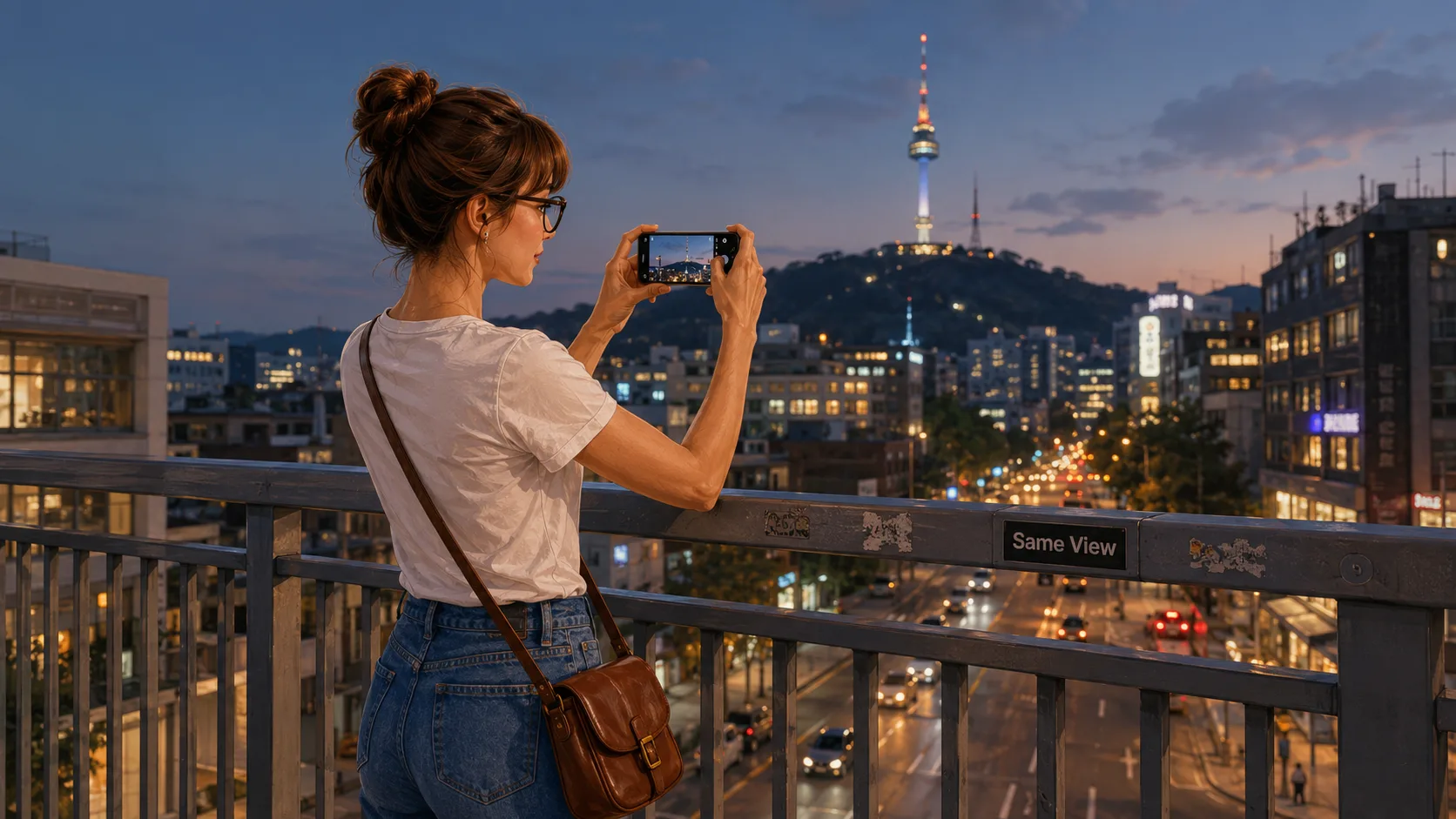

Photo Tip
Shoot during blue hour, just before the sky goes dark, to capture both the color of the sky and the lights of N Seoul Tower.
Do not block foot traffic on the overpass, and keep your photo session brief when fewer people are passing.
Dinner Between Itaewon and Haebangchon
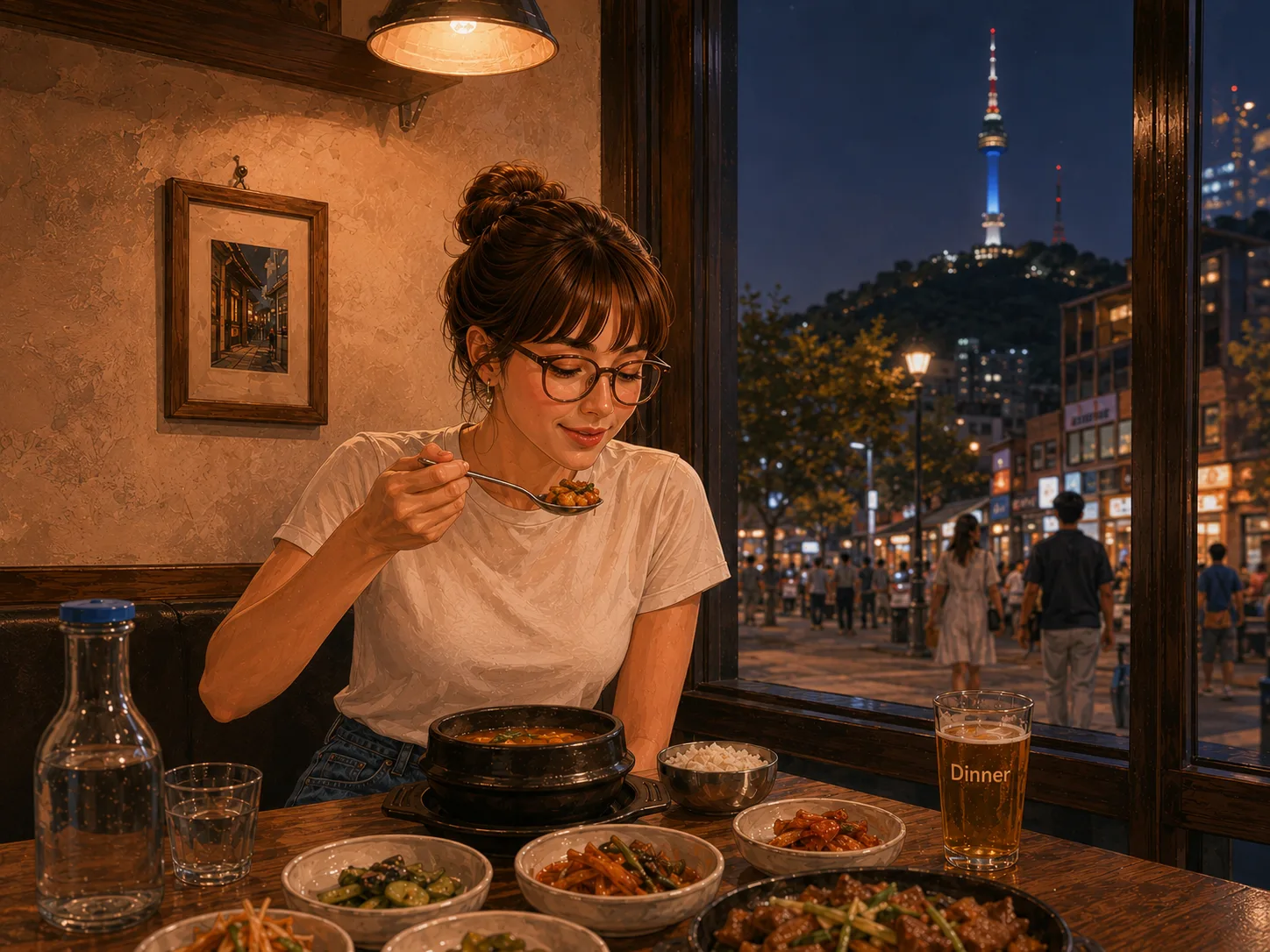
After taking photos, Maya walked toward Gyeongnidan-gil and stepped into a small Korean restaurant.
In dramas, Itaewon had always seemed like a dramatic setting for conflict and new challenges. On a real evening, it was a neighborhood where people having dinner after work mingled with residents walking their dogs and travelers climbing the hills.
Some shops that once served as famous filming locations may no longer be there, or their names and interiors may have changed. Neighborhoods and businesses continue to evolve after a series has aired.
Maya actually liked that the places were not identical to what she had seen on screen.
It was proof that Seoul was not one enormous film set, but a city where everyday life continued long after the story ended.
How to Compare a Scene with the Real Place
Maya looked back on the day’s journey.
After walking through Seoul all day, she decided it was fine if the real views differed slightly from the scenes on screen. In fact, part of the fun was discovering alleys and everyday lives that the camera never showed.
In Bukchon, Maya walked quietly and looked around instead of rushing to take photos. After seeing the filming location, she stopped by a nearby museum and restaurant. She had come to find a single scene but felt as though she had enjoyed an entire day in Seoul.
Maya’s route was simple:
Bukchon — Animation & Hanok
Deoksugung — K-Drama & Stone Wall
Noksapyeong — Drama View & N Seoul Tower
The three places are not connected on foot, so allow time to travel between them by subway.
If your schedule is tight, pairing Bukchon with Deoksugung or choosing only Noksapyeong and Itaewon is more than enough.
The Real Seoul Maya Discovered
Back at her accommodation, Maya placed the scenes from the screen beside the photos she had taken that day.
The Seoul of animation was brighter and more dramatic, while the drama’s alleys were quieter and more romantic than they were in real life.
But her real-life photos contained something the stories did not.
People slowly climbing a narrow street, office workers passing the stone wall, and streams of headlights beneath the overpass.
That was when Maya understood.
‘The joy of visiting places from the screen isn’t about copying the exact same shot. It’s about discovering the next scene of Seoul, still unfolding beyond the frame.’
The day became an unforgettable memory for Maya.
Comments 0
Please log in to comment.
No comments yet. Start the conversation.