

Korean Barbecue for First-Timers: Everything You Need to Know
Maya, the main character in this article, is a fictional American traveler visiting Korea.
Rather than overstating what makes Korean barbecue special,
this informative story introduces the culture in a relaxed, approachable way for first-time diners.
A few days into her stay in Seoul, Maya made dinner plans with a Korean friend.
The menu was something she had heard about countless times but had never actually tried: Korean barbecue.
Barbecue and steak were familiar to her from the United States, but Korean barbecue had a slightly different atmosphere.
There was a grill in the middle of the table, meat cooking over it, side dishes spread all around, and lettuce wraps to assemble. It was a slow, social meal built around conversation.
After her first bite, Maya thought,
“This is not just a meal where you eat meat. The fun is in grilling and eating it together.”

Popular cuts to know before you start
The first thing that confused Maya as she looked at the menu was the names of the cuts.
But once you know a few basics, it is not as difficult as it seems.
These are some of the cuts you will often see at Korean barbecue restaurants.
• Samgyeopsal: pork belly
This is the best-known option. Its alternating layers of fat and lean meat give it a rich, familiar flavor.
• Moksal: pork neck
It has less fat than samgyeopsal but remains tender and pleasantly chewy, which makes it a favorite for many diners.
• Galbi: marinated ribs
Think of ribs in a sweet-and-savory marinade. Restaurants may serve either beef galbi or pork galbi.
• Hangjeongsal: pork jowl
There is not much of it on each animal, but its springy texture and rich flavor make it a popular cut.
• Woosamgyeop / Chadolbaegi: thin beef slices
Because the slices are thin, they cook quickly and are an easy, approachable beef option.
For a first meal, Maya's approach works well:
Start with samgyeopsal or moksal. They are popular, make a useful baseline for comparing flavors, and offer an easy introduction to Korean barbecue.

There is a reason for the grilling order
When the meat arrived at the table, Maya naturally wondered,
“What should we grill first?”
There is no single absolute rule at Korean barbecue, but it is usually easiest to grill unseasoned meat first and marinated meat afterward.
The reason is simple.
Marinated meat is more likely to burn and leave sauce on the grill.
A common order is:
1. Start with plain cuts such as samgyeopsal or moksal.
2. Then grill marinated meat such as galbi.
Side ingredients such as kimchi, garlic, mushrooms, and onions are often cooked around the edge of the grill.
They can become even more flavorful as they absorb some of the meat drippings.
Maya found this sequence surprisingly fun.
It felt natural to begin with clean, basic flavors and then move on to richer, bolder ones once her palate had adjusted.


Ssam does not need a perfect formula
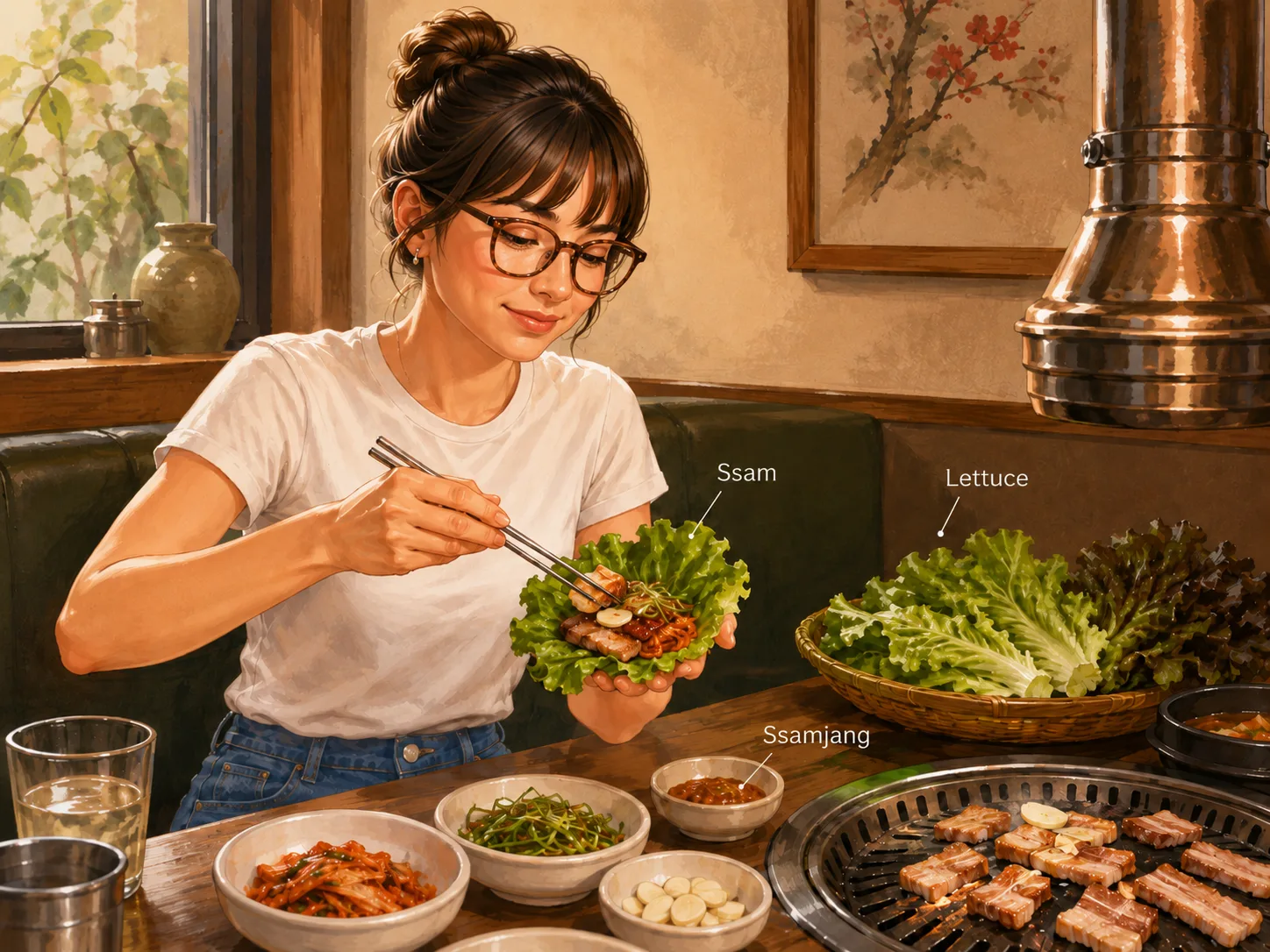
The part Maya enjoyed most was making ssam, or Korean lettuce wraps.
You place a piece of grilled meat on lettuce or a perilla leaf, then add small amounts of ssamjang, garlic, green onion salad, kimchi, rice, or anything else you like before eating it in one bite.
First-time international diners sometimes worry, “Is there a correct way to do this?” “How do I wrap it properly?” and become more nervous than they need to be.
In reality, ssam is very flexible.
A simple version looks like this:
• Lettuce or a perilla leaf
• Grilled meat
• Ssamjang
• Optional garlic, kimchi, or green onion salad
That alone is enough.
If you add too much, it may actually become difficult to eat in one bite.
Maya got a little ambitious and made her first wrap too large, then burst out laughing.
By the second one, however, she already felt much more natural.
She quickly realized that ssam is less about mastering a wrapping technique and more about finding the combination that tastes good to you.
Side dishes are supporting players that make the meal richer
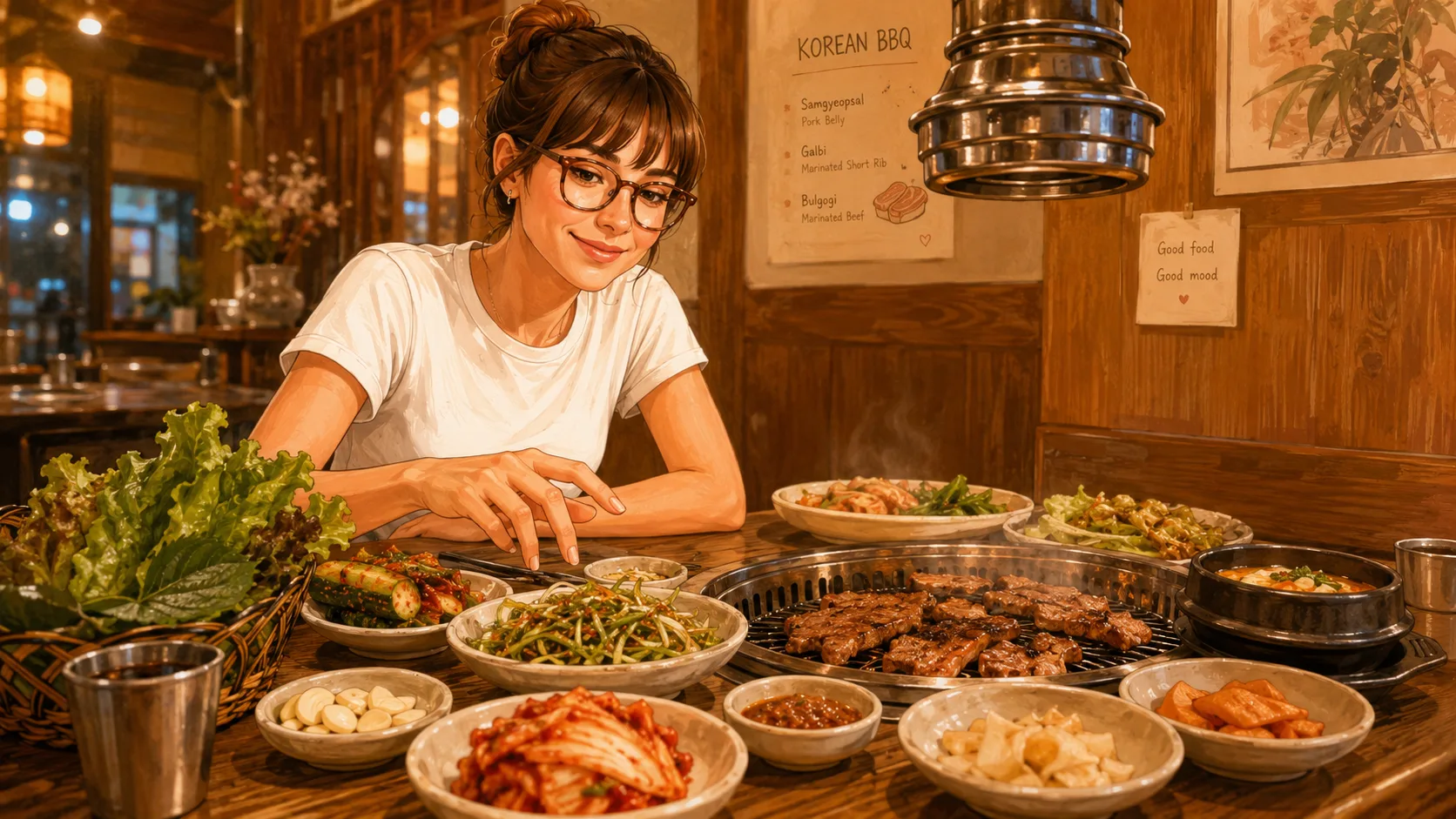
Another surprise for Maya at the barbecue restaurant was that several side dishes arrived all at once even though she had ordered only meat. They were included at no extra charge, and many could be refilled for free.
The exact selection varies by restaurant, but common side dishes include:
• Kimchi
• Pickled radish or other pickles
• Green onion salad
• Bean sprouts
• Seasoned vegetables
• Dipping sauces
• Garlic and chili peppers
These dishes are not merely decoration. Each one wakes up the palate and plays an important role in balancing and complementing the meat.
Eating kimchi after a rich bite of pork refreshes the mouth, while green onion salad adds a brighter, fresher note.
The flavor also changes depending on whether you use ssamjang, salt, or a sesame-oil dipping sauce. Maya especially loved ssamjang, whose savory, slightly sweet flavor was difficult to describe but easy to enjoy.
She discovered that it could make not only meat but even plain vegetables taste satisfying.
Maya felt that one of the best things about Korean barbecue was not only the flavor of the meat itself, but also the chance to create a different combination with every bite.
Restaurants where staff grill the meat are especially convenient for first-time visitors
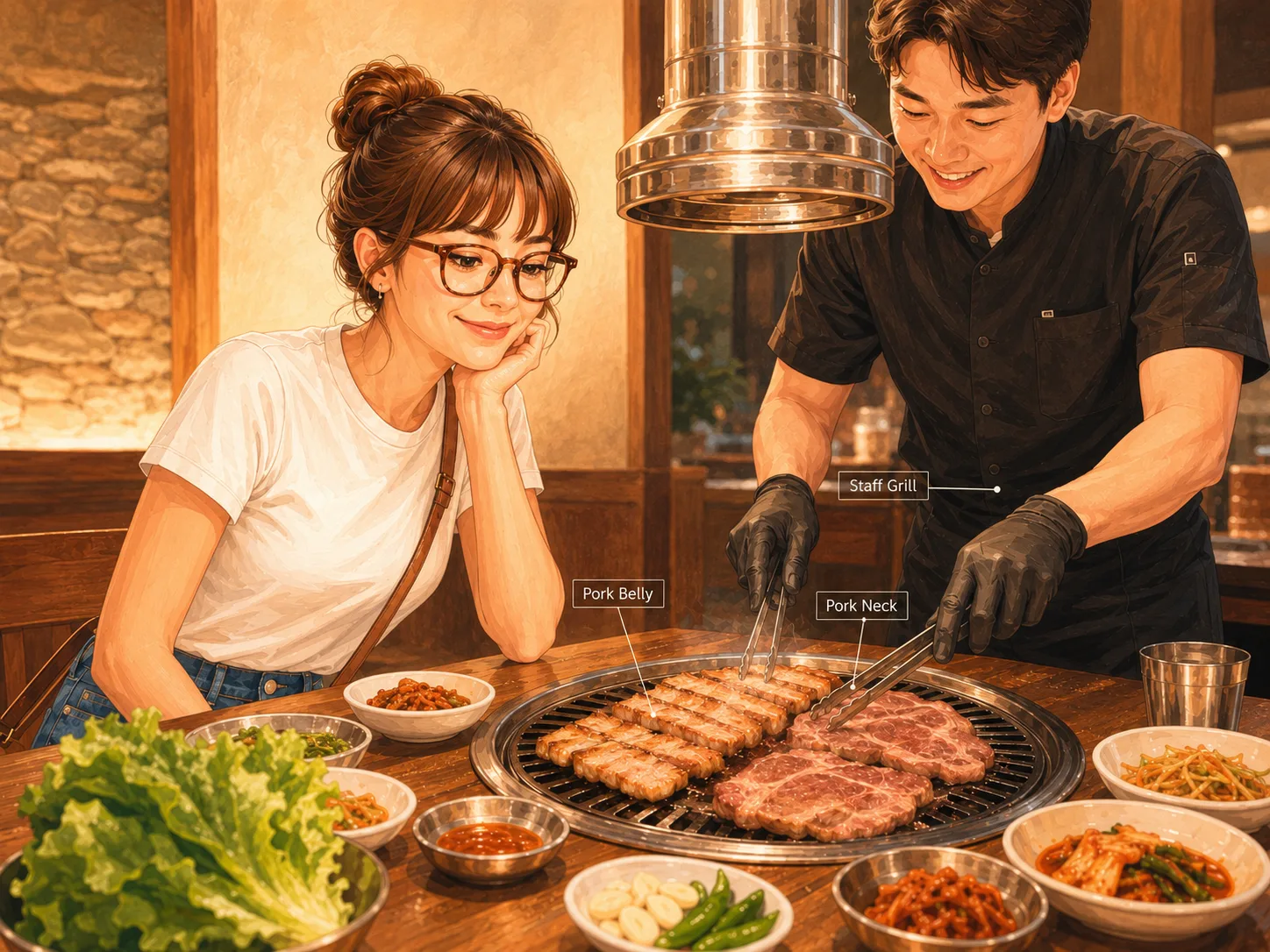
One thing Maya found particularly reassuring was that more restaurants than she expected had staff members who grilled the meat at the table.
Not every Korean barbecue restaurant offers this service, but many popular samgyeopsal restaurants, moksal specialists, and galbi restaurants have staff who help from the first turn of the meat through cutting it into bite-size pieces.
The advantages are simple:
• You do not have to worry about when to turn the meat.
• It is easier to reach the most delicious level of doneness.
• First-time diners can focus more fully on the meal.
Maya had initially felt a little nervous because she assumed she would have to grill everything herself,but she relaxed as soon as the staff member began managing the grill with ease.
Instead of spending the meal worrying about technique, she could focus on enjoying the food.
Maya's first Korean barbecue memory
The rhythm of waiting for the meat to cook, having it cut into bite-size pieces, and placing one piece on lettuce to make a wrap became familiar much faster than she expected.
Maya tried a bite of samgyeopsal, then moksal, then each cut with kimchi and again with green onion salad.
Every combination tasted slightly different.
The samgyeopsal was richer, while the moksal was leaner but still had a satisfying texture.
With kimchi, the meat tasted familiar yet refreshing, and in a lettuce wrap, it felt much lighter.
The final highlight was eating naengmyeon with the meat. A warm slice of grilled meat on top of cool, tangy, chewy noodles turned out to be a memorable combination of its own.
Most of all, Maya liked that Korean barbecue was not a meal to rush through, but one to enjoy while grilling, sharing, and talking together.
As she left the restaurant, Maya thought,
“At first I hesitated because I did not know how to eat it, but now I understand—the greatest pleasure of Korean barbecue is sharing it with other people.”
Final thoughts
There is no need to feel intimidated by Korean barbecue on your first try.
Remembering just a few things is enough.
• Begin with approachable cuts such as samgyeopsal or moksal.
• Grill marinated meat later.
• Keep your ssam simple and make it your own way.
• Enjoy the side dishes as part of what makes each bite richer.
• For a first visit, a restaurant where staff grill the meat may be much more comfortable.
With just these basics, Korean barbecue becomes far easier to approach.
For Maya, her first Korean barbecue was more than a chance to try an unfamiliar food. It became a special moment when she experienced Korea's evening culture of eating, sharing, and enjoying time together.
Comments 0
Please log in to comment.
No comments yet. Start the conversation.