

10 Korean Phrases for Asking for Help—even If You Don’t Speak Korean
Maya, who appears in this article, is a fictional character based on an American traveling in Korea.
Rather than teaching you to speak perfect Korean, this article introduces short, polite ways to ask for help when you need it during your trip.
Before arriving in Seoul, the only Korean Maya knew was “annyeonghaseyo” (hello) and “gamsahamnida” (thank you).
Once her trip began, she realized she needed something more useful than long sentences: short expressions she could use immediately when she got lost, thought she had boarded the wrong bus, or needed to order at a restaurant.
Maya saved 10 Korean phrases in the notes app on her phone.
Her pronunciation was awkward at first, but when she spoke slowly and showed a map or photo at the same time, people understood her in most situations.
What mattered more than perfect grammar was clearly communicating what she needed.

The First Phrase to Remember
When it is difficult to explain exactly what has gone wrong during your trip, start with this phrase.
1. 도와주세요
Do-wa-ju-se-yo
Please help me. (<-Many Koreans will understand this sentence even if you say it in English.)
Maya first used this phrase when her transit card did not work at a subway gate.
After saying “도와주세요” and showing her card, a station employee pointed her toward the reload machine.
This is the most basic expression to use when you cannot solve a problem on your own. However, if you are facing an immediate crime or medical emergency, call 112 or 119 directly instead of only asking nearby people for help.
When You Are Lost
In Seoul, even when a destination looks close on the map, it can be difficult to find the building entrance or the right alley.
Rather than struggling to pronounce the name of her destination, Maya showed the map on her phone and asked a short question.
2. 여기 어떻게 가요?
Yeo-gi eo-tteo-ke ga-yo?
How do I get here?
As you say “여기” (here), point to the destination marked on the map.
3. 지하철역이 어디예요? (It is easier to get directions if you ask for a specific station by name.)
Ji-ha-cheol-yeok-i eo-di-ye-yo?
Where is the subway station?
Instead of “지하철역” (subway station), you can show a map or photo of another place you are looking for, such as a restroom, bus stop, or police station.
Even if your Korean pronunciation is not exact, showing the screen and pointing in the right direction makes your meaning much easier to understand.

When Taking a Bus or Taxi
Before boarding a bus, Maya showed the driver her destination and asked a short question.
4. 이 버스가 여기 가요?
I beo-seu-ga yeo-gi ga-yo?
Does this bus go here?
Point to your destination on the map as you speak.
Even if the driver says it is the right bus, it is safer to check the direction on the stop information display or in a map app as well.
In a taxi, showing the address in Korean may be more accurate than giving a long explanation.
5. 이 주소로 가 주세요
I ju-so-ro ga ju-se-yo
Please take me to this address.
Maya took a screenshot of her accommodation’s Korean address in advance and showed it to the driver. Preparing both the street address and the nearest subway station, rather than showing only the accommodation’s name, can reduce the chance of going to a place with a similar name.

When Ordering at a Restaurant
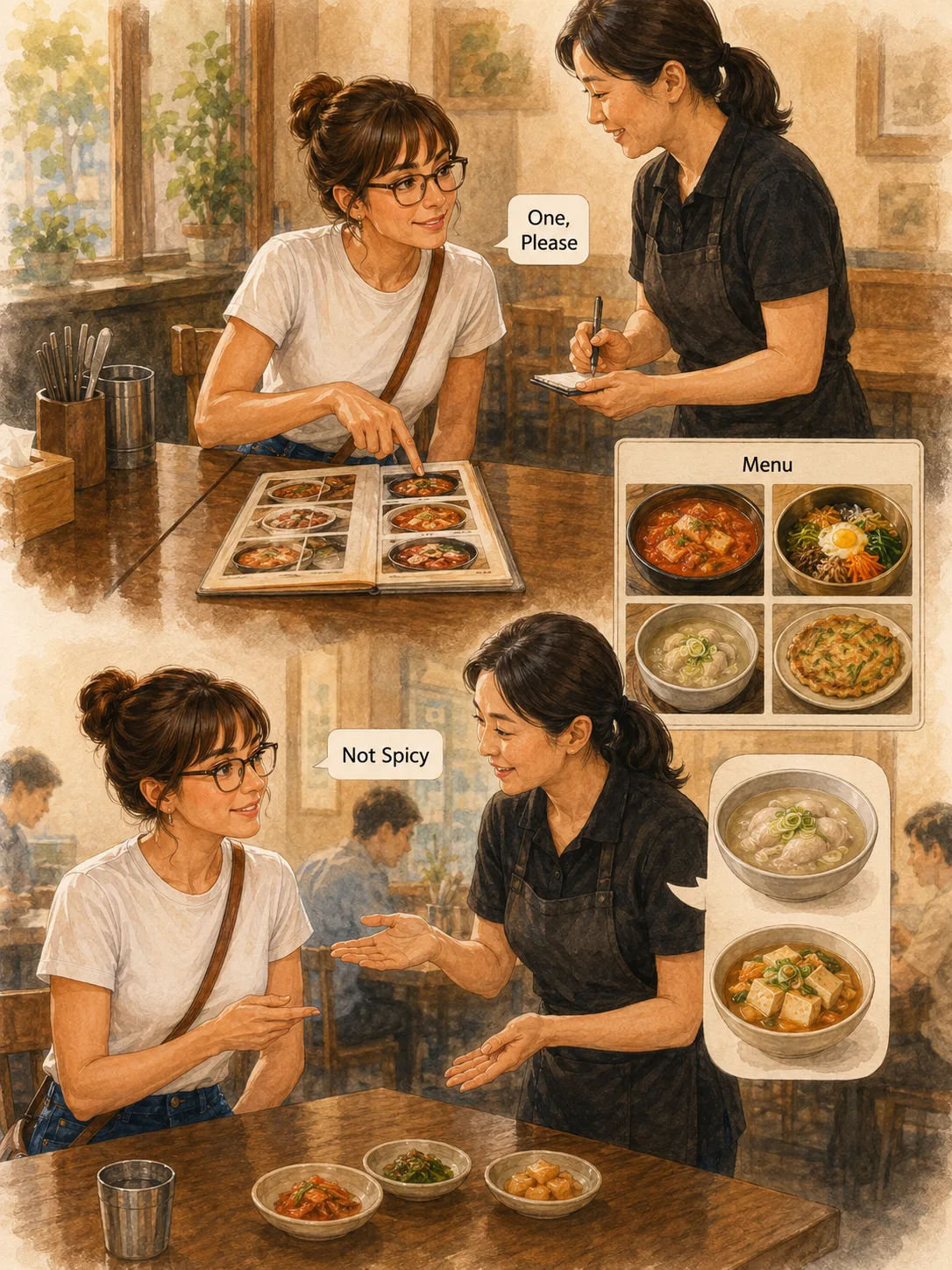
Many restaurants in Korea have photos on their menus or let customers order from a tablet at the table.
Simply point to the photo and use this phrase.
6. 이거 하나 주세요
I-geo ha-na ju-se-yo
One of these, please.
“이거” means “this.” If you want more than one, it is helpful to show the quantity with your fingers.
What worried Maya most was the level of spiciness.
7. 안 매운 음식 있어요?
An mae-un eum-sik i-sseo-yo?
Do you have non-spicy food?
Use this phrase to ask whether there are any non-spicy dishes.
However, what counts as “not spicy” in Korea can vary from person to person.
If you can barely tolerate spicy food, it is safer to show “No chili pepper, please” or your allergy information on a translation screen as well.
When You Are Sick or Need to Go to a Hospital
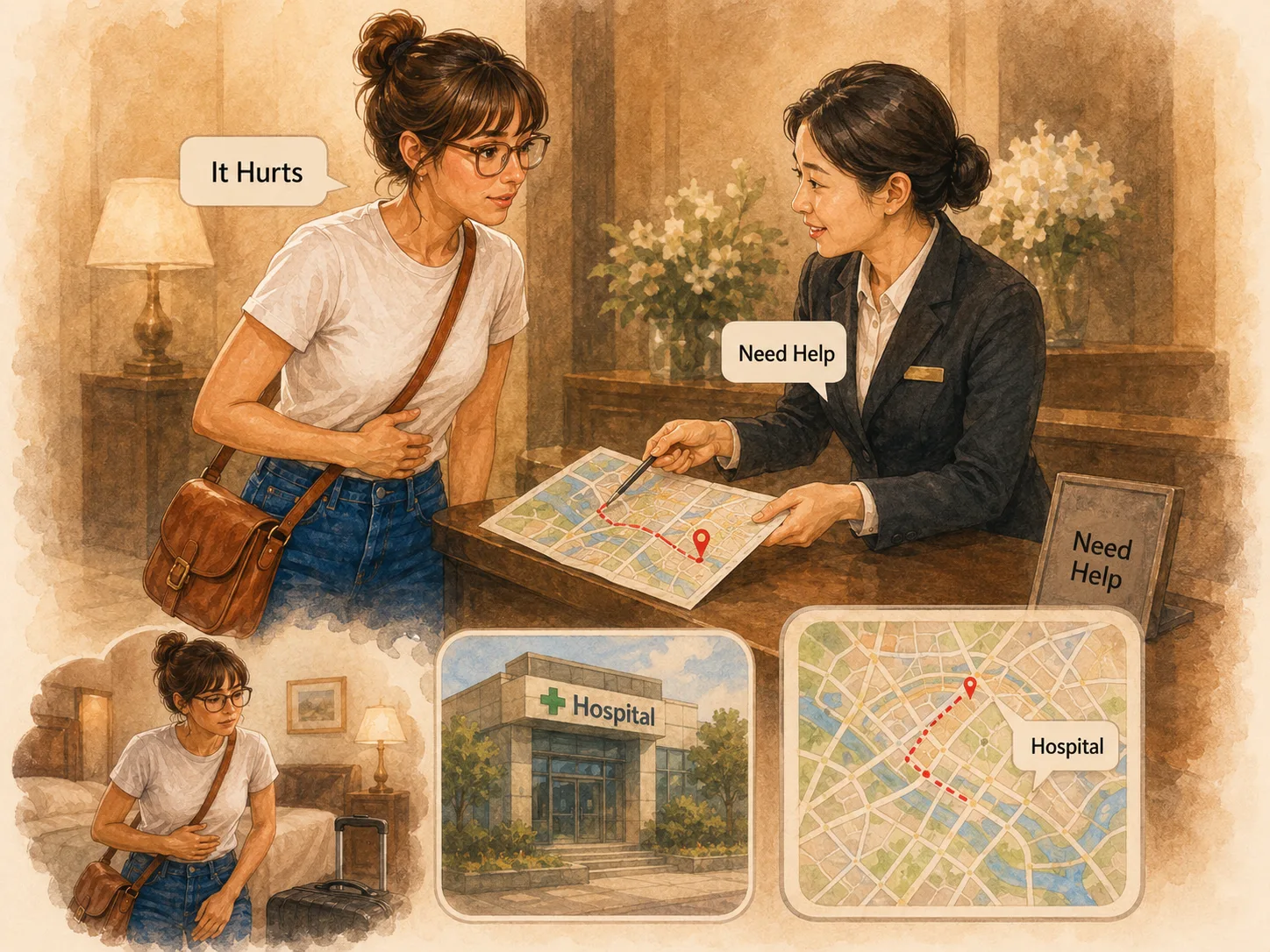
When you feel unwell, pointing directly to the painful area is faster than trying to use difficult medical terms.
8. 여기가 아파요
Yeo-gi-ga a-pa-yo
It hurts here.
Say “여기” (here) while pointing to your head, stomach, throat, or the injured area.
If your symptoms are severe or you need to go to a hospital, use the next phrase.
9. 병원에 가야 해요
Byeong-won-e ga-ya hae-yo
I need to go to a hospital.
When Maya developed severe stomach pain during her trip, she showed this phrase to a staff member at her accommodation and was directed to a nearby hospital.
If someone is unconscious, having difficulty breathing, bleeding heavily, or seriously injured, call 119 for emergency medical assistance instead of trying to find a hospital on your own.
When You Lose Something
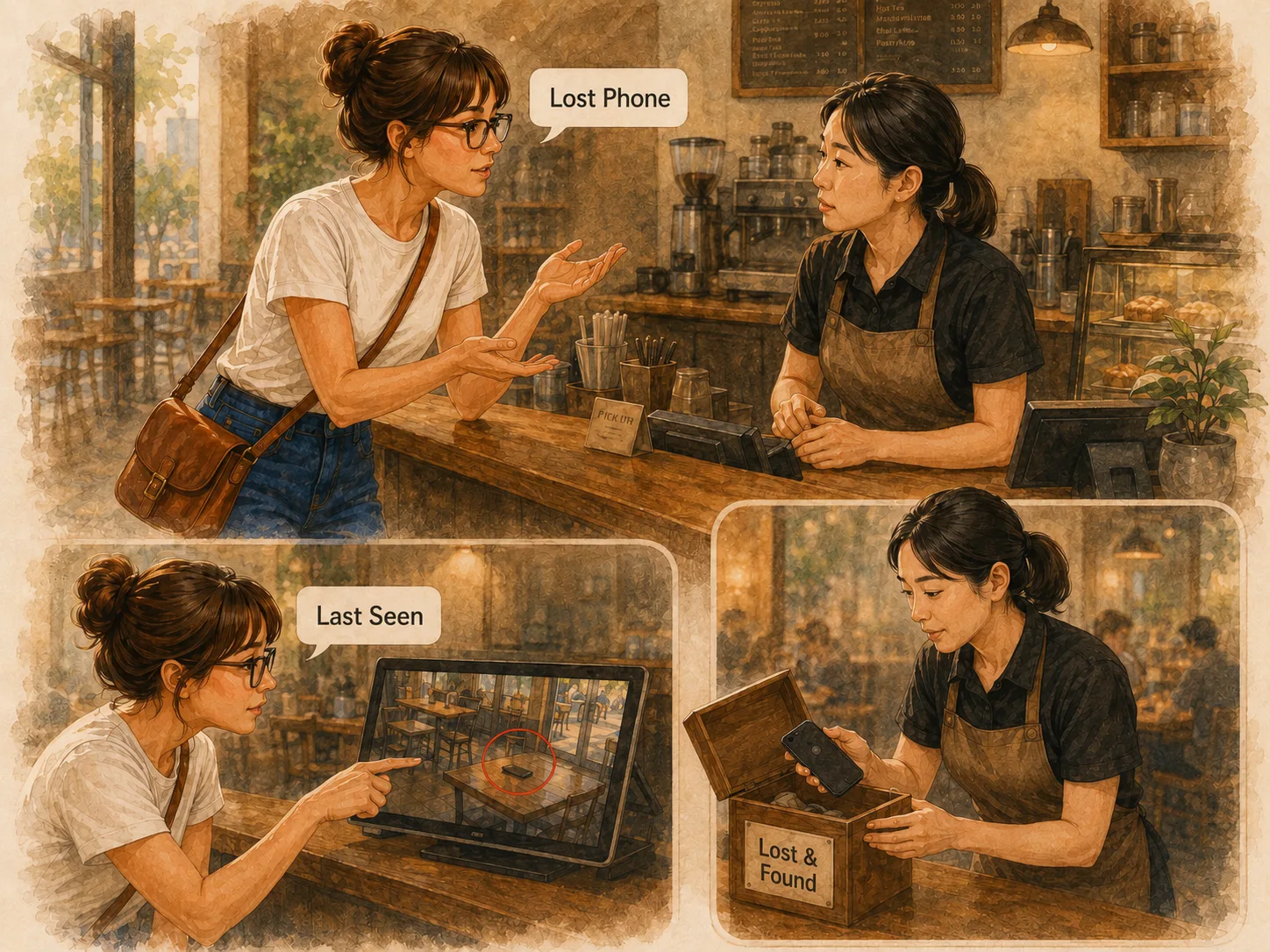
After leaving a café, Maya realized that her phone was missing and returned to the shop.
She showed a staff member a photo of her phone and said:
10. 휴대전화를 잃어버렸어요
Hyu-dae-jeon-hwa-reul il-eo-beo-ryeo-sseo-yo
I lost my phone.
You can replace “휴대전화” (phone) with the name of another item.
• 여권을 잃어버렸어요 — I lost my passport
• 지갑을 잃어버렸어요 — I lost my wallet
• 가방을 잃어버렸어요 — I lost my bag
If the pronunciation is difficult, show a photo of the missing item and simply say “잃어버렸어요”to help the other person understand the situation.
If you suspect theft or need police assistance, call 112. For general tourist interpretation or guidance to the appropriate agency, you can call 1330.
What Maya Actually Did
Maya did not try to memorize all 10 phrases.
She saved them in separate groups by situation, enlarged the relevant phrase on her phone when needed, and showed the screen to the other person.
When speaking, she paused slightly between words instead of reading them quickly.
도와주세요.
여기, 어떻게 가요?
이거, 하나 주세요.
After saying the Korean phrase, it was more effective to show a map, address, menu photo, or the painful area than to give a long explanation in English.
After receiving help, she said one short phrase:
감사합니다 — Gam-sa-ham-ni-da — Thank you.

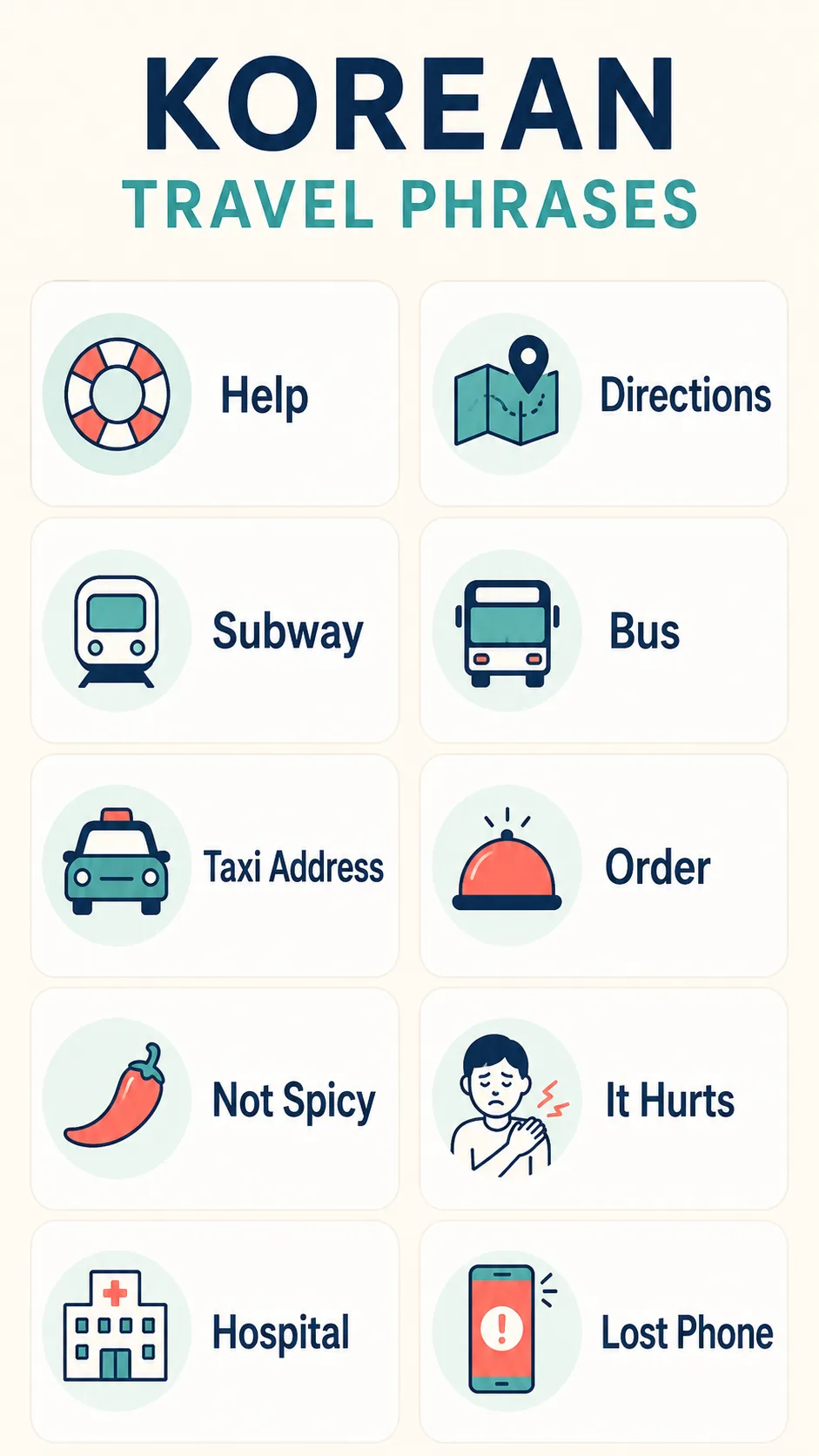
10 Useful Phrases to Save
1. 도와주세요
Please help me.
2. 여기 어떻게 가요?
How do I get here?
3. 지하철역이 어디예요?
Where is the subway station?
4. 이 버스가 여기 가요?
Does this bus go here?
5. 이 주소로 가 주세요
Please take me to this address.
6. 이거 하나 주세요
One of these, please.
7. 안 매운 음식 있어요?
Do you have non-spicy food?
8. 여기가 아파요
It hurts here.
9. 병원에 가야 해요
I need to go to a hospital.
10. 휴대전화를 잃어버렸어요
I lost my phone.
By the end of her trip, Maya still could not hold a long conversation in Korean.
But in most situations, she could solve the problem simply by saying a short phrase when needed, showing her screen, and carefully watching the other person’s gestures.
The Korean you need while traveling may not be perfect sentences, but a few phrases that give you the courage to ask for help.
Comments 0
Please log in to comment.
No comments yet. Start the conversation.