

Women's Health Screenings: When to Start and What to Check
Maya, who appears in this article, is a fictional character inspired by an American traveler visiting Korea.
Rather than encouraging anyone to seek medical care, this storytelling article is intended to explain Korea’s women’s health screening system and overall atmosphere in an easy-to-understand way.
While staying in Seoul, Maya heard her Korean friend say this.
“In Korea, many people make a point of getting checkups before they feel sick. Once you reach certain ages, the government supports health screenings, and women are encouraged to get certain screenings in advance.”
Maya, who had lived in the United States, found that interesting.
She was used to going to the doctor after symptoms appeared, but Korea’s approach of getting age-appropriate screenings in advance and keeping an eye on one’s health was new to her.
It made Maya wonder, “When do women in Korea usually start getting checked, and what do they look at?”

Korea’s women’s health screenings are easiest to understand as “national screening + individual needs”
The first thing Maya learned was that health screenings in Korea generally follow two tracks.
The first is the national health screening program.
Once people reach certain ages, they may receive information about basic health checks or cancer screenings at the national level.
The second consists of additional checks based on individual circumstances.
For example, someone may visit an OB-GYN or another relevant department if they have severe menstrual pain, irregular periods, a family history, plans for pregnancy, or concerns about a specific area such as the breasts or thyroid.
In other words, women’s health screening in Korea can be understood as follows:“There are standard screenings, and you add checks based on what is happening in your own body.”
That is a fairly accurate way to think about it.

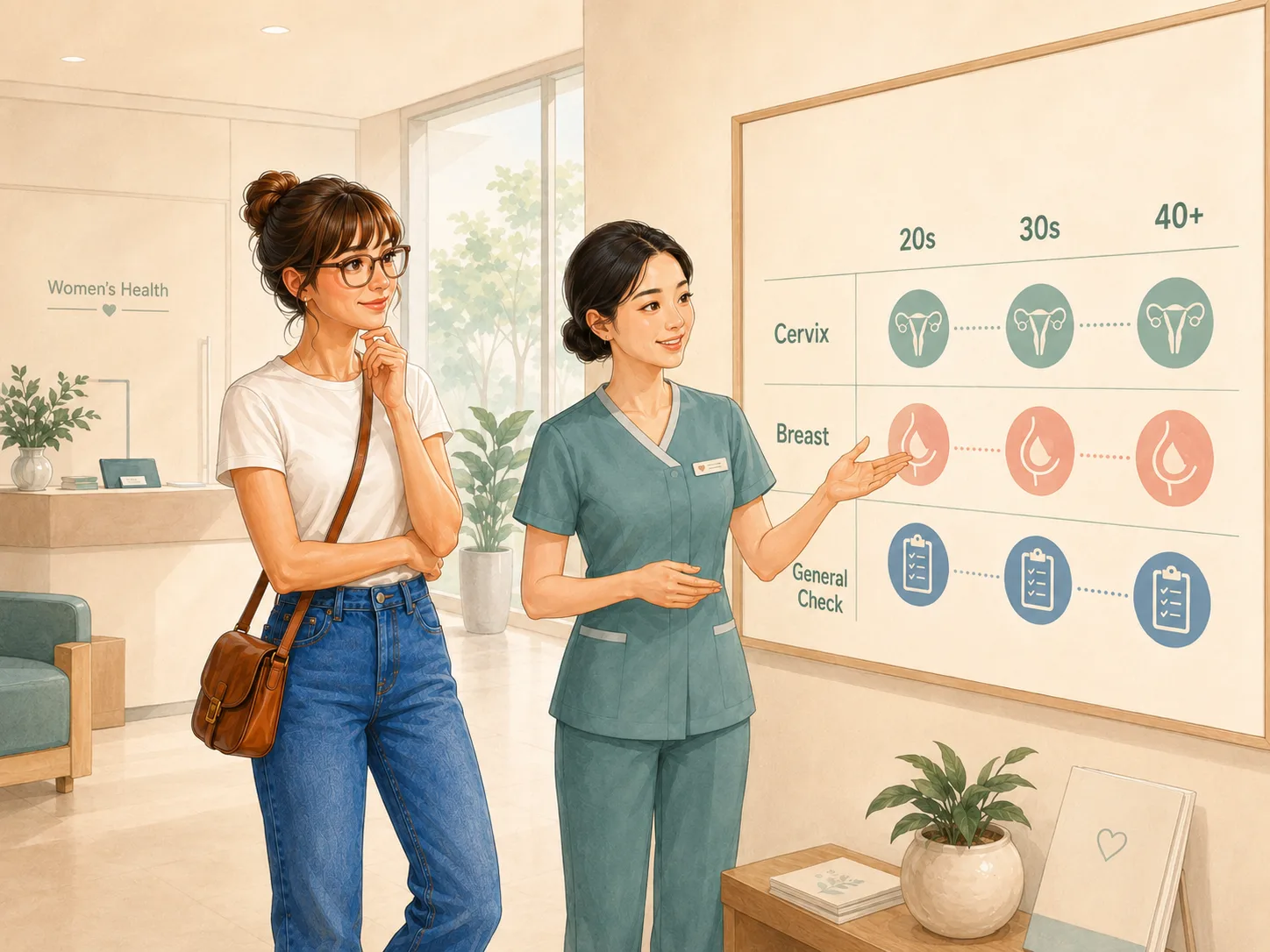
Your 20s: “A time not to miss unusual signs”
Maya first heard about what matters in one’s twenties.
For women in their twenties in Korea, the important habit was not only screening for serious disease, but also paying close attention to changes in the body.
Examples include:
• Whether menstrual cycles are extremely irregular
• Whether menstrual pain or bleeding differs from usual
• Whether discomfort such as vaginitis, pain, or changes in discharge keeps recurring
• If sexually active, when to begin cervical screening
• Whether HPV vaccination, sexual health, or contraceptive counseling is needed
In Korea, visiting an OB-GYN is not only about pregnancy or a serious illness.
People also commonly go for everyday reasons such as menstrual concerns, contraceptive counseling, vaginitis, or routine health screening.
Medical facilities are relatively accessible, and consultations and necessary treatment can often proceed fairly quickly, contributing to a culture in which people do not feel overly burdened about visiting a clinic.
Cervical cancer screening, in particular, is one of the checks many women become aware of relatively early in adulthood.
However, the starting age, interval, and method can vary according to national guidelines and individual circumstances, so it is safest to follow a clinician’s advice for actual decisions.
At this point, Maya understood something characteristic of Korean healthcare.
“A health screening isn’t a test you get only when you’re sick. It’s a way to check on your body while you’re healthy.”

Your 30s: “When lifestyle and women’s health begin to come into view together”
In one’s thirties, the scope of health concerns becomes a little broader.
Work, sleep, stress, changes in weight, and plans for pregnancy or childbirth all add more factors that can affect health.
In Korea, interest in the following areas often grows during this period, in addition to basic screening:
• Overall well-being, including anemia, fatigue, and lack of sleep
• Commonly discussed gynecological issues such as uterine fibroids and ovarian cysts
• A health check before pregnancy
• Attention to breast health
• Consultations about the thyroid, weight changes, and hormones
Of course, not everyone undergoes the same tests.
In Korea as well, the appropriate checks vary according to symptoms, family history, pregnancy plans, and previous test results.
That is why it is becoming increasingly important to understand why a test is being considered and make an informed choice, rather than simply saying, “Everyone else does it, so I should too.”
What impressed Maya most was that health screening was not about having as many tests as possible. It was about choosing screenings suited to her age and health and checking important concerns in advance.

Age 40 and beyond: “When national cancer screening and regular checks become more important”
Maya was struck by how regular health monitoring becomes increasingly important from one’s forties onward.
She also noted that the Korean government substantially expands the types of national screenings available after age 40 to support disease prevention.
From this stage, the connection to national cancer screening for breast, cervical, colorectal, and stomach cancers becomes more visible in Korea.
• Cervical cancer screening: an important check for adult women from a relatively early stage
• Breast cancer screening: regular screening becomes more important after age 40
• Colorectal cancer screening: often considered from middle age onward
• Stomach cancer screening: national screening every two years from age 40 to support early detection and prevention
• When needed, broader attention to bone density, menopause-related counseling, and cardiovascular health
The important point is that screening in Korea is not simply “done once and finished.” The things to check change with age.
Maya was a little surprised to hear that her friend’s mother checked and planned her screening schedule in advance every year.
She was impressed that health screening was not treated as something exceptional, but had become a habit for managing one’s health.

What stands out in Korea is not simply speed, but “a systematic approach”
Maya did not look only at the advantages of Korean healthcare.
There were also practical matters to consider, including waiting times, costs, differences in care among hospitals, and language barriers. Still, women’s health screening felt relatively systematic to her.
For example:
• The distinction between basic and additional screening is relatively clear
• Access to OB-GYN care is generally not poor
• For many people, screening, consultation, and follow-up have become part of everyday routine
• There is also an understanding that a hospital is not only “somewhere you go when you are sick,” but also “somewhere you go to check”
Of course, not every medical institution in Korea is the same.
Test options, the way information is explained, English-language support, and costs can vary by hospital.
So the most realistic way to understand Korean healthcare is:“Its screening culture is relatively well developed, but the actual experience varies by institution.”
That is a balanced way to see it.

Maya’s takeaway
At the end of the day, Maya summed it up this way.
“Women’s health screening in Korea isn’t only for people with special concerns,
It is closer to a process of checking how the body changes with age and asking the questions you need to ask.”
That may be the simplest way to explain Korean healthcare.
It does not mean that getting as many tests as possible is always the right answer, nor does it mean that visitors to Korea must use medical services.
Still, Korean society clearly has a culture of thinking about women’s health by age group and checking it before symptoms appear.
That is the starting point for understanding women’s health screening.
At first, Maya found this kind of screening unfamiliar, but the more she heard, the more she understood that looking after her health in advance could be one way of caring for herself.
Comments 0
Please log in to comment.
No comments yet. Start the conversation.